Wednesday, March 7, 2012 2 comments

Interesting points on the Lord’s commendation of Alma


This commendation from the Lord comes as Alma the Elder inquired what to do about the widespread transgression in the church.
15 Blessed art thou, Alma, and blessed are they who were baptized in the waters of Mormon. Thou art blessed because of thy exceeding faith in the words alone of my servant Abinadi.
16 And blessed are they because of their exceeding faith in the words alone which thou hast spoken unto them. (Mosiah 26:15-16)
This seems to indicate that when Alma was converted, it wasn’t because Abinadi had authority but because Alma had faith in the truth Abinadi shared. And when Alma taught King Noah’s people in secret, it seems they didn’t believe because any institutional legimacy he had from being a priest (rather, he had lost his institutional legitimacy in the eyes of King Noah and the other priests and could have lost it in the eyes of the other people as well), but they believed simply in the words that Alma shared. They believed the truth.

The Lord calls it “exceeding faith” to believe in a single witness’s words of truth, and when you think about how much effort it takes to teach people these days, we can see how true that is. The Lord sends multiple witnesses to testify of the truth, so when someone believes with just one witness, it is something special.
And blessed art thou because thou hast established a church among this people; and they shall be established, and they shall be my people. (Mosiah 26:17)
For a long time I didn’t understand why the Lord would commend Alma for doing what it seemed like he should have done anyway, but then I ran across this verse:
Now king Mosiah had given Alma the authority over the church. (Mosiah 26:8)
It seems that perhaps Alma didn’t strictly have the authority to organize a church in Shilom or in Helam, but he was given it by King Mosiah in Zarahemla, which means that the church meetings at the waters of Mormon and in Helam were a sort of grassroots organization, an anticipatory church.

Because Alma was a priest at that time, he had authority to baptize and ordain other priests and teachers, but it seems he didn’t necessarily have the authority to establish a church, yet the people gathered together anyway, and they acted like a church anyway, under his leadership.

I think this initiative to prepare themselves to be churched was what the Lord was praising Alma for.

This would also explain why Alma was skittish about rendering judgment on people’s transgressions. If he had been more used to being a grassroots authority who taught and baptized, the prospect of rendering judgment might seem uncomfortable. It would feel like over-stepping his authority. We also know that he was worried he would do wrong, perhaps worried he would make bad judgments like King Noah and his priests had done. And too, perhaps his days as a sinner came back to him and it was hard to judge those who may have committed the same sins he had.

The instructions the Lord gives afterward are good hard fast doctrine of how to tell who should stay in the church and who should be blotted out from the rolls. Alma, who seems to have only previously dealt with repentant people who wanted in, would appreciate this doctrine.

For me, this story seems more like an encouragement toward taking the initiative as a leader. I wonder how many problems could be solved in the church with innovative leadership? I know in the Great Depression, Harold B. Lee was a stake president who was challenged with finding a way to help the members of his stake, more than half of whom were unemployed.
Here was a challenge, a terrifying challenge, for the young stake president. He worried, he wept, he prayed, as he saw men, once proud and prosperous, reduced through unemployment to a point where they could not feed their families. Then came inspiration to establish a storehouse where food and commodities could be gathered and from which they could be dispersed to the needy. Work projects were undertaken, not only to improve the community, but, more importantly, to afford men an opportunity to work for what they received. An old business building was demolished and the materials were used to construct a stake gymnasium to provide social and recreational facilities for the people. Other stakes were engaged in similar projects… (Teachings of Presidents of the Church: Harold B. Lee, p. xvi)
On April 20, 1935, Harold B. Lee was called into the office of the First Presidency. They knew him as a young stake president who had been successful in caring for the poor and needy. According to Harold B. Lee,
President Grant…said that there was nothing more important for the Church to do than to take care of its needy people and that so far as he was concerned, everything else must be sacrificed [so that] proper relief [could be] extended to our people. I was astounded to learn that for years there had been before them, as a result of their thinking and planning and as a result of the inspiration of Almighty God, the genius of the very plan that was waiting and in preparation for a time when, in their judgment, the faith of the Latter-day Saints was such that they were willing to follow the counsel of the men who lead and preside in this Church. (Teachings of Presidents of the Church: Heber J. Grant, p. xxiii)

It seems that what surprised Harold B. Lee was that the First Presidency had been waiting and planning to put the welfare plan into operation, and it struck him that what he had been doing in his stake to help his people was demonstrating to the First Presidency that the time to put those plans into action had come.

It seems there is a principle at work here. The best way I can describe it is this way: we show we are ready for change or revelation to come when we move toward it first.
Sunday, March 4, 2012 0 comments

Good desires and reward

And now I command you, that if you have good desires—a desire to lay up treasures for yourself in heaven—then shall you assist in bringing to light, with your gift, those parts of my scriptures which have been hidden because of iniquity. (D&C 6:27)

I like this verse because I feel like it doesn’t just speak to Oliver Cowdery about translating the Book of Mormon, but I feel it speaks to me and anyone else who works to understand the scriptures and write about them for other people.


I also like that it highlights that it is a good desire to want to lay up treasures in heaven. Laying up treasure in heaven usually means doing something that is not necessarily praised or rewarded on earth. It’s not rewarded on earth because the world doesn’t know how to estimate the true value of spiritual things, and even if it could, it doesn’t have the power or resources to reward adequately.


Fortunately, God can reward now and later, as is shown in v20, 33-34:

…Be faithful and diligent in keeping the commandments of God, and I will encircle thee in the arms of my love….

33 Fear not to do good, my sons, for whatsoever ye sow, that shall ye also reap; therefore, if ye sow good ye shall also reap good for your reward.

34 Therefore, fear not, little flock; do good; let earth and hell combine against you, for if ye are built upon my rock, they cannot prevail.

We see that we are rewarded by being encircled about in the arms of God’s love, we are promised a harvest of a good reward, and we are promised that we will prevail over the opposition that will come.


Which parts of this reward come now and which parts come later? In what ways have you felt that you’ve received some reward from God?

Thursday, March 1, 2012 1 comments

Blameless Service


Therefore, O ye that embark in the service of God, see that ye serve him with all your heart, might, mind and strength, that ye may stand blameless before God at the last day. (D&C 4:2)


This verse touched me as I had been preparing for my calling as primary music leader. For some reason I’ve been getting overwhelmed lately by different life demands, and I’ve been more inclined to retreat and wish things away rather than face them. When I ran across this verse, it reminded me that I can do my best.


This verse has a neat promise it it—that of standing blameless at the last day on condition of putting our heart, might, mind, and strength into our service.

  • Heart—courage to carry on, feeling
  • Might—physical strength
  • Mind—knowledge and intellectual ability
  • Strength—physical and mental capability; energy or intensity

I don’t know if it is necessarily that we are to attack our service as if it were a weight-lifting competition, grunting and groaning all the way. Rather, it seems as if the Lord means us to become immersed in the great range of experiences that go with giving service. He wants us to feel everything that goes with it, to think everything through, to study it all out, to experience both the success that elates, and the disappointment that requires courage and heart to carry on, and use all our resources and faculties.. and discover new ones. (If that sounds like living a life of service to the fullest, it is probably because it is.) I think He wants us to put all of that into our service because any of it may be the deciding factor that helps someone else come to repentance. If we hold anything back, that may have been the one thing that would have worked. But if we have used all our heart, might, mind, and strength, then we will be blameless because we have done all we could do. (And doing all we can do qualifies us for the grace of God. He will make us what He wants us to be.)


One additional note: The section summary has an interesting perspective on this verse. It says, “valiant service saves the Lord’s ministers.” Here’s my question to you—is “standing blameless” the same as being saved? Discuss. Why or why not?


Image: http://maxmeadfitness.com/tag/weightlifting/

Monday, February 27, 2012 3 comments

Prayer can be a sacred grove experience


Two days ago, my husband and I were reading February’s home teaching message by President Eyring “Exhort Them to Pray” in preparation for giving it to a fellow who was in prison. Somehow I found myself somewhat puzzled by the concluding statement of the first five paragraphs.

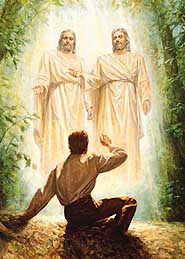
When I was a little child, my parents taught me by example to pray. I began with a picture in my mind of Heavenly Father being far away. As I have matured, my experience with prayer has changed. The picture in my mind has become one of a Heavenly Father who is close by, who is bathed in a bright light, and who knows me perfectly.

That change came as I gained a sure testimony that Joseph Smith’s report of his experience in 1820 in Manchester, New York, is true:

“I saw a pillar of light exactly over my head, above the brightness of the sun, which descended gradually until it fell upon me.

It no sooner appeared than I found myself delivered from the enemy which held me bound. When the light rested upon me I saw two Personages, whose brightness and glory defy all description, standing above me in the air. One of them spake unto me, calling me by name and said, pointing to the other—This is My Beloved Son. Hear Him!” (Joseph Smith—History 1:16-17).

Heavenly Father was in the grove on that beautiful spring day. He called Joseph by name. And He introduced the resurrected Savior of the world as His “Beloved Son.” Whenever and wherever you pray, your testimony of the reality of that glorious experience can bless you. (Henry B. Eyring, “Exhort Them to Pray”, Feb 2012 Ensign, 4, bold added)

That last sentence puzzled me—“Whenever and wherever you pray, your testimony of the reality of that glorious experience can bless you.” It seemed too general to me to be helpful, so I asked my husband what he thought about it. "How can our testimony of the First Vision bless us?" My husband came back with this great thought: whenever and wherever we are, we can pray as if we are Joseph Smith in that grove of trees and have our own little sacred grove experience as we think of Heavenly Father close by listening.


I think this is what President Eyring is getting at. Because of his testimony of the First Vision, he no longer prays imagining Heavenly Father far away. He prays imagining Heavenly Father present in a pillar of light exactly over his head with a brightness and glory that defy all description, ready to speak and answer.


Elder Erying writes, “He hears our prayers as He heard Joseph’s prayer—as clearly as if they were being offered in His presence.” If He hears our prayers that clearly, then to all intents and purposes, He is in our presence, and we will benefit more from remembering and imagining that when we pray.


This week I’m trying to remember that when I pray. So far it has made prayer a very powerful experience. Will you try this experiment with me this week?


Image: http://www.lds.org/library/display/0,4945,104-1-3-4,00.html

Sunday, February 19, 2012 2 comments

Molting insects and putting off the natural man


I was reading about insects yesterday and I ran across a fabulous picture of an insect molting and it seemed to me that it was a great metaphor and image for putting off the natural man.

For the natural man is an enemy to God, and has been from the fall of Adam, and will be, forever and ever, unless he yields to the enticings of the Holy Spirit, and putteth off the natural man and becometh a saint through the atonement of Christ the Lord, and becometh as a child, submissive, meek, humble, patient, full of love, willing to submit to all things which the Lord seeth fit to inflict upon him, even as a child doth submit to his father. (Mosiah 3:19)

A number of insects molt because they have to grow and their exoskeleton does not grow with them. So, they have to break through the crusty bounds of what they once were. The split in their exoskeleton that allows them to break out happens because of an increase of pressure from their hemolymph. (Hemolymph is to insects what our blood is to us.) Essentially, they expand from within. Their souls expand.

See from these verses how the word of God and the Holy Ghost acts spiritually on us in this very same way, bringing us gradually to put off the natural man:

28 Now, we will compare the word unto a seed. Now, if ye give place, that a seed may be planted in your heart, behold, if it be a true seed, or a good seed, if ye do not cast it out by your unbelief, that ye will resist the Spirit of the Lord, behold, it will begin to swell within your breasts; and when you feel these swelling motions, ye will begin to say within yourselves—It must needs be that this is a good seed, or that the word is good, for it beginneth to enlarge my soul; yea, it beginneth to enlighten my understanding, yea, it beginneth to be delicious to me….

34 And now, behold, is your knowledge perfect? Yea, your knowledge is perfect in that thing, and your faith is dormant; and this because you know, for ye know that the word hath swelled your souls, and ye also know that it hath sprouted up, that your understanding doth begin to be enlightened, and your mind doth begin to expand. (Alma 32:28-34, emphasis added)

And again I ask, were the bands of death broken, and the chains of hell which encircled them about, were they loosed? I say unto you, Yea, they were loosed, and their souls did expand, and they did sing redeeming love. And I say unto you that they are saved. (Alma 5:9, emphasis added)

We see from Alma 5:9 that when our souls expand, just as the insect escapes their old exoskeleton, we escape "the bands of death" and "the chains of hell."

The image of an insect molting from its old skin is a powerful way to help us understand the need to have our souls expand and put of the natural man. Isn't it cool that the Lord gave us these little lessons as part of our beautiful world?

Image: Insect Exoskeletons, http://www.backyardnature.net/exoskelt.htm, retrieved 2/14/12.

Friday, February 17, 2012 6 comments

Consider your desires

Behold, O ye my people, or my brethren, for I esteem you as such, I desire that ye should consider the cause which ye are called to consider—for ye are desirous to have a king. (Mosiah 29:5)

These words are in the context of Mosiah trying to get the people’s input on who should be the next king over the Nephites. In this verse, Mosiah begins his letter in which he will give his best reasons why it would not be good to have a king. The words of this verse suggest that it is important for us to think about the things we want and consider WHY we want them. When we consider WHY we want things, often we are confronted with our shoddy thinking or unrighteous motivations. Acknowledging that our motives are bad or our good reasons are lacking can help us relinquish unrighteous desires.

I went through a phase a few years after I was married when I really wanted a tiara. And I didn’t want a little toy one; I wanted a really fancy-nice one. I wanted to be the queen of our house and wear it around. I wasn’t going to wear it other places, just at home. I’m not sure why I wanted it, other than I wanted to look extra special to myself and my husband. If the tiara that I wanted had been inexpensive, my husband probably would have gotten it for me, but it wasn’t. (After all, those rhinestones cost money!) And as he asked me why I wanted it, I realized that my reasons weren’t really good enough, so eventually I relinquished all serious intention of getting one. Deep, deep down, I suppose my motive for getting a tiara was all about stroking my own pride and vanity.

I’ve wanted to be famous. I can’t remember when this was, but I know I wanted it at some point. And I don’t know why I wanted it. Maybe I thought fame would bring happiness or that fame was the same as being appreciated or worthwhile. Now I know that is rarely the case, and thank goodness I didn’t have to become famous to discover that.

I’ve wanted to be rich. I’ve wanted to start a business. I’ve wanted to be an inventor. And you what? I’ve wanted those things for all the wrong reasons.

Yes, it is good to consider the reasons why we want what we want.


Tell me about some not-so-worthy desires that you've learned to relinquish. How did you come to let them go?


Wednesday, February 15, 2012 1 comments

Lessons from the conversion of Alma the younger

We’re familiar with the principle that change is possible for all of us, which the story of Alma the Younger’s conversion teaches. We’re also familiar with the principle that praying for others to be brought to the truth is powerful, as Alma’s father did for him. But I also recently noticed another principle as I was reading Mosiah 27 recently.

24 For, said he, I have repented of my sins, and have been redeemed of the Lord; behold I am born of the Spirit.

25 And the Lord said unto me: Marvel not that all mankind, yea, men and women, all nations, kindreds, tongues and people, must be born again; yea, born of God, changed from their carnal and fallen state, to a state of righteousness, being redeemed of God, becoming his sons and daughters;

26 And thus they become new creatures; and unless they do this, they can in nowise inherit the kingdom of God. (Mosiah 27:24-26, emphasis added)

Alma was told personally by the Lord that his experience of conversion was something that EVERYONE had to go through in order to inherit the kingdom of heaven. All of us must go through the same mighty change of heart that Alma went through, or we will be cast off as he was nearly cast off.

Alma had to realize his awful state to make any progress. We must also realize our awful state. The faster we realize it, the faster we can repent. We need to realize the wrongs we have done to know what we must repent of. This is not a comfortable thing to do, but it must be done, otherwise we are like those that Nephi spoke of who say “All is well in Zion, yay, Zion prospereth, all is well” and then have our souls cheated and led down to hell. I have found that the best way is to ask the Lord to reveal to me the truth of what I need to repent of.

Alma’s predicament is ours, and his mighty change can be ours too, if we call on the Lord for mercy as he did.

Monday, February 13, 2012 2 comments

His soul shall never hunger nor thirst, but shall be filled

And he [Jesus] said unto them: He that eateth this bread eateth of my body to his soul; and he that drinketh of this wine drinketh of my blood to his soul; and his soul shall never hunger nor thirst, but shall be filled. (3 Nephi 20:8)

I was reading reading randomly through the scriptures and I noticed this particular verse. The context is Jesus administering the sacrament to the Nephites. Somehow I noticed what a difference it makes between if Jesus had said “eatheth of my body to his body” and what He did say, which was “eateth of my body to his soul.” Jesus said this eating bread and wine of the sacrament was to our souls, not our bodies. It is amazing that the sacrament can benefit our spirits with this little act of eating, which normally would only benefit our bodies.

It’s an amazing promise that goes with it. To those of us who eat the bread and wine to our souls, we are promised our souls “shall never hunger nor thirst, but shall be filled.” What might that mean to us to never have a hungry, thirsty soul? What might it mean to always be filled? How would that bless our lives? What might it feel like?

I know my soul is filled when I take the sacrament. I can feel it. (I think I began to really notice it in my late teens.) I’m sure you have felt it too. For me, it is as if all the holes in my soul are filled in and smoothed over, the cracks joined and glued together. I can feel my desires to do good are renewed and strengthened.

I can keep it a few days, but usually by Saturday I feel like I am struggling a bit. After looking at that verse, though, it seems to me like there has to be something I can do to keep that “filled” feeling in my soul. Perhaps I need to remember Jesus more. I am both haunted and inspired by that promise that my soul “shall never hunger nor thirst, but shall be filled.”

What might it mean to us in the middle of our trials and troubles and afflictions if our soul never hungers or thirsts but is filled? How might a “filled” soul handle inevitable difficulties? How might a “filled” soul deal with heavy responsibility? Is a “filled” soul resilient? Serene? Hopeful? (Obviously I need to really internalize these promises..)

I was asking myself these questions, and interestingly enough a little later, I ran across a scripture that showed me the opposite of “filled.”

It shall even be as when an hungry man dreameth, and, behold, he eateth;

but he awaketh, and his soul is empty:

or as when a thirsty man dreameth, and, behold, he drinketh;

but he awaketh, and, behold, he is faint, and his soul hath appetite:

so shall the multitude of all the nations be, that fight against mount Zion. (Isaiah 29:8)

So it seems that being filled is meant to help us escape the terrible predicament that Isaiah described of having a hungry, dissatisfied soul. It seems to be a benefit of knowing you are on the right track and walking in the true way we’re supposed to go.

If you’ve had experience with fulfillment of this promise, will you share what it is you do to do your part?

Saturday, February 11, 2012 9 comments

Aminadi interprets the writing on the wall


We learn of Aminadi from Amulek when Amulek begins his message to the rebellious Ammoniha-ites
2 I am Amulek; I am the son of Giddonah, who was the son of Ishmael, who was a descendant of Aminadi; and it was that same Aminadi who interpreted the writing which was upon the wall of the temple, which was written by the finger of God.
3 And Aminadi was a descendant of Nephi, who was the son of Lehi, who came out of the land of Jerusalem…(Alma 10:2-3)
That little bit about Aminadi interpreting the writing upon the walls of the temple which was written by the finger of God is so fascinating. It is one of those places where I just want to shake Mormon for not putting in more detail, but at the same time, I know that adding more detail would have disrupted Amulek’s narrative flow.

It is fascinating how briefly Amulek refers to the story of his ancestor Aminadi. It suggests that Aminadi’s interpretation was so widely known to the people that it was an important part of their historical narrative of faith and could be referred to in a much abbreviated form, much as we speak of Joseph Smith’s first vision.

The finger of God writing on the wall of the temple would have been a great story to include, and I can’t imagine that it wasn’t included in the abridgement of the large plates of Nephi. I think it may have been a casualty of the 116 pages being lost. Yet we have just enough details for it to evoke our knowledge of the story of Daniel interpreting the writing on the palace wall for the king of Babylon. We can sort of piece together the story of Aminadi based on the story of Daniel.

In the Bible, the finger of the Lord wrote the message for the Babylonian king, but because the king didn’t understand it, Daniel was the one to interpret the writing. So, I suppose that in the Americas, the Lord wrote the message for someone or some people, but because they didn’t understand it, Aminadi was called to interpret (or came forward to interpret) the writing on the temple wall.

That the writing is on the temple wall is very intriguing. In Daniel’s story, the writing was on the palace wall where the king was. In the Book of Mormon, the writing was on the temple wall, suggesting that the priests (or a priest-king) administering in the temple were being condemned for idolatry and abominations, and a view of the writing finger of God was needed to convince them of the existence, power, and authority of God.

I think it was probably the highest-ranking priest (or possibly priest-king, since at that time kings often held the top religious authority as well) that was getting the message from the finger of God. If it had just been lower ranking priests, then the higher-ranking one(s) could admonish them. But when it is the highest ranking doing the bad stuff and leading the people astray, that would definitely be grounds for direct admonishment from God.

The writing comes to the place and person(s) who need(s) it. That the writing needs interpretation indicates that the person(s) to whom it comes is so out of tune that they don’t understand it. The person needing the interpretation must find an interpreter, so both the writing (and the subsequent interpretation) will become very publicly known. It seems to me that this is the way the Lord rebukes a person in power who should have known better; He does it in order to make sure everyone else knows not to do those same sins.

Why does Amulek mention this story of his ancestor at the beginning of his talk to the Ammonihah-ites? I think he is setting some context for his message of repentance by locating himself as a fitting person to deliver the message. Just as Aminadi interpreted a message from God to the people of his day who were out of tune with the Lord, Amulek will be interpreting a warning message from God (along with Alma) to the people of his day who are very much out of tune with God. I think Amulek drew strength from the story of his ancestor as he delivered the difficult message.

How does this little story help us today? I think knowing the valiant and righteous choices of our ancestors can help us make valiant and righteous choices in our own lives. Hearing how our parents and grandparents and great-grandparents and more distant ancestors sacrificed for the truth can encourage us when we find ourselves called upon to do it too. As a small example, I know that when my mom told me about how she worked to dress modestly in the ‘60s even when she was made fun of at high school, it helped give me strength to follow her good example and dress modestly.

How have the stories of your ancestors inspired you? Have there been times when you have found yourself doing something good that was very similar to what one of your ancestors did? How did it make you feel? How are you working to transmit those stories to your family?

Thursday, February 9, 2012 2 comments

Multiple records give a truer picture

Notice the difference between these two records:

Noah-Limhi record

34 And it came to pass that Alma and the people of the Lord were apprised of the coming of the king’s army; therefore they took their tents and their families and departed into the wilderness….

1 And it came to pass that the army of the king returned, having searched in vain for the people of the Lord. (Mosiah 18:34-19:1)

Alma record

1 Now Alma, having been warned of the Lord that the armies of king Noah would come upon them, and having made it known to his people, therefore they gathered together their flocks, and took of their grain, and departed into the wilderness before the armies of king Noah.

2 And the Lord did strengthen them, that the people of king Noah could not overtake them to destroy them. (Mosiah 23:1-2)


The difference in viewpoints gives us a more accurate picture. The Noah-Limhi record of Mosiah 18:34-19:1 states that Alma and his people were “apprised of the coming of the king’s army,” but the Alma record of Mosiah 23:1-2 shows us it was the Lord who warned Alma that King Noah’s army would come. The Noah-Limhi record indicates how King Noah’s people thought some person must have warned them, implying they didn’t think God could warn them. It is nice to have Alma’s record because then we learn the truth—that the Lord can warn us ahead of time to flee dangers.

Also, the Alma record of Mosiah 23:1-2 shows that Alma’s people believed that the armies of King Noah were very close to catching them and the Lord strengthened them that the armies could not overtake them. But the Noah-Limhi record of Mosiah 19:1 shows us that the armies of King Noah searched in vain for Alma’s people and couldn’t find them anywhere. This shows the Lord warned quite a bit in advance, and Alma and his people were obedient to the Lord’s warning, leaving quickly enough that King Noah’s armies had not a clue where they had gone. Chasing simply never entered the case. It is nice that we have this record too because we get a truer picture of what happened.

The Nephites seem to have learned this benefit too.

5 And it came to pass that Mosiah did read, and caused to be read, the records of Zeniff to his people; yea, he read the records of the people of Zeniff, from the time they left the land of Zarahemla until they returned again.

6 And he also read the account of Alma and his brethren, and all their afflictions, from the time they left the land of Zarahemla until the time they returned again.

7 And now, when Mosiah had made an end of reading the records, his people who tarried in the land were struck with wonder and amazement.

8 For they knew not what to think; for when they beheld those that had been delivered out of bondage they were filled with exceedingly great joy.

9 And again, when they thought of their brethren who had been slain by the Lamanites they were filled with sorrow, and even shed many tears of sorrow.

10 And again, when they thought of the immediate goodness of God, and his power in delivering Alma and his brethren out of the hands of the Lamanites and of bondage, they did raise their voices and give thanks to God.

11 And again, when they thought upon the Lamanites, who were their brethren, of their sinful and polluted state, they were filled with pain and anguish for the welfare of their souls.

12 And it came to pass that those who were the children of Amulon and his brethren, who had taken to wife the daughters of the Lamanites, were displeased with the conduct of their fathers, and they would no longer be called by the names of their fathers, therefore they took upon themselves the name of Nephi, that they might be called the children of Nephi and be numbered among those who were called Nephites. (Mosiah 25:5-12)

In this block of verses, Mosiah reads to the people the records of Zeniff-Noah-Limhi and Zeniff-Noah-Alma. It seems there is such a mixture of good and bad in these stories (and we see it for ourselves) that there is a mixture of reactions, both happy and sad. The Nephites seem to have thought about what they heard from all the angles—Limhi’s people (both survivors and slain), Alma’s people, the Lamanites, and the Amulonites.

On this occasion the children of Amulon and the wicked priests of Noah hear about their fathers in a totally new way, and they so dislike what they hear that they decide to call themselves by some other name than the names of their fathers. (And by the way, these children of Amulon-and-priests are not the children by the Lamanite mothers. These are the children who had been left behind with Limhi’s people, and escaped with Limhi’s people. *)

If there had only been the record of Zeniff, perhaps the children of Amulon and the wicked priests would never have learned about the things their fathers had done, but because Alma also kept a record, they found out.

What does this mean for us today? It reminds us of the record we make of our lives; someday our descendants are going to read it. But not only that, in the judgment day when all the books are opened and we are judged according to those things that were written, we may find that other people have written about us too in their records. It will be a mix of good and bad. Perfidies that we have committed and whitewashed in our own record will be presented in all the scarlet hues of hurt. And if we haven’t repented, what will be the result? Won’t our children wish to do the same thing as Amulon’s children did? Won’t they be displeased with us and wish to be part of a different family?

The principle in these verses is very valuable to us. It is that multiple records of our acts (both good and bad) are being kept besides our own and someday they will be read and known. We want good things to be found instead of bad things.


* No matter which set of children the Book of Mormon refers to, Amulon’s and his wicked fellows would not have a good account. His children by the Lamanite women would have found out the whoredoms of their fathers with King Noah and their part in the martyrdom of Abinadi. Their children who had been left behind with the people of Limhi would have found out the treachery of their fathers in joining the Lamanites and their cruelty enslaving and persecuting Alma’s people. Either way, their case was pretty awful.