Showing posts with label wealth. Show all posts
Saturday, July 29, 2017 2 comments

The Test of Ease


The July 2017 Ensign had a really good article from Elder Bednar called “On the Lord’s Side: Lessons from Zion’s Camp” (p27) that had a big section in it that I want to comment on.

The leaders of the Lord’s Church clearly have identified some of the collective or generational tests we can expect to encounter in our day and generation. As the President of the Quorum of the Twelve Apostles in 1977, President Ezra Taft Benson (1899–1994) raised a prophetic voice of warning in a meeting of regional representatives. I now quote extensively from President Benson’s message and invite your focused attention on his timely counsel:

“Every generation has its tests and its chance to stand and prove itself. Would you like to know of one of our toughest tests? Hear the warning words of Brigham Young, ‘The worst fear I have about this people is that they will get rich in this country, forget God and His people, wax fat, and kick themselves out of the Church and go to hell. This people will stand mobbing, robbing, poverty, and all manner of persecution and be true. But my greatest fear is that they cannot stand wealth.’”

President Benson continues: “Ours then seems to be the toughest test of all, for the evils are more subtle, more clever. It all seems less menacing and it is harder to detect. While every test of righteousness represents a struggle, this particular test seems like no test at all, no struggle and so could be the most deceiving of all tests.

“Do you know what peace and prosperity can do to a people—It can put them to sleep. The Book of Mormon warned us of how Satan, in the last days, would lead us away carefully down to hell. The Lord has on the earth some potential spiritual giants whom He saved for some six thousand years to help bear off the Kingdom triumphantly, and the devil is trying to put them to sleep. The adversary knows that he probably won’t be too successful in getting them to commit many great and malignant sins of commission. So he puts them into a deep sleep, like Gulliver, while he strands them with little sins of omission. And what good is a sleepy, neutralized, lukewarm giant as a leader?

“We have too many potential spiritual giants who should be more vigorously lifting their homes, the kingdom, and the country. We have many who feel they are good men and women, but they need to be good for something—strong patriarchs, courageous missionaries, valiant family history and temple workers, dedicated patriots, devoted quorum members. In short, we must be shaken and awakened from a spiritual snooze.”7

Consider that affluence, prosperity, and ease can be tests in our day equal to or greater in intensity than the persecution and physical hardships endured by the Saints who volunteered to march in Zion’s Camp. As the prophet Mormon described in his magnificent summary of the pride cycle contained in Helaman 12:

“And thus we can behold how false, and also the unsteadiness of the hearts of the children of men; yea, we can see that the Lord in his great infinite goodness doth bless and prosper those who put their trust in him.
“Yea, and we may see at the very time when he doth prosper his people, yea, in the increase of their fields, their flocks and their herds, and in gold, and in silver, and in all manner of precious things of every kind and art; sparing their lives, and delivering them out of the hands of their enemies; softening the hearts of their enemies that they should not declare wars against them; yea, and in fine, doing all things for the welfare and happiness of his people; yea, then is the time that they do harden their hearts, and do forget the Lord their God, and do trample under their feet the Holy One—yea, and this because of their ease, and their exceedingly great prosperity” (Helaman 12:1–2).

I invite you specifically to note the final phrase in the last verse: “and this because of their ease, and their exceedingly great prosperity.”

President Harold B. Lee (1899–1973) likewise taught about the collective test of ease that we face in our day: “We are tested, we are tried, we are going through some of the severest tests today and we don’t realize perhaps the severity of the tests we are going through. In those days there were murderings, there were mobbings, there were drivings. They were driven out into the desert, they were starving and they were unclad, and they were cold. They came here to this favored land. We are the inheritors of what they gave to us. But what are we doing with it? Today we are basking in the lap of luxury, the like of which we’ve never seen before in the history of the world. It would seem that probably this is the most severe test of any test that we’ve ever had in the history of this Church.”

So, Elder Bednar notes that affluence, prosperity, and ease can be tests in our day equal to or greater in intensity than the persecution and physical hardships endured by the Saints who volunteered to march in Zion’s camp.

Many of us might listen or read these words and like Tevye from “Fiddler on the Roof” we might say, “Well, if wealth is a curse, may God smite me with it! And may I never recover!”

But that just shows we don’t understand the danger. So many of us are driven and motivated to action by the needs of the moment, driven to acquire what will enable us to live, driven by the needs of those who depend on us.  But what happens when we reach a state when our needs are all met, when no one makes any demands? It sounds wonderful. But where will you find motivation if you have no need?

That is the test. The test is to create your motivation and stay anxiously engaged in a good cause day by day, week by week, month by month, year by year. The test is to keep it up, even though you don’t need to. The test is to sacrifice your comfort and ease to bring about righteous purposes. The test is to push out of ease willingly into a cause fraught with frustration, inconvenience, difficulty, challenge, persecution, pain, etc.  And it is a test.  The natural man and woman loves to loll about and will protest when you think about trying something know or doing something hard that you don’t have to do.  (At least mine does.)

It is true that ease puts people to sleep. When there’s no need, you feel like you don’t have to try too hard because the penalty for failure or laziness is low. That is how prosperity saps people of vigor.

Again, Elder Bednar points out the test of affluence, prosperity, and ease can be equal to or greater in intensity than the persecution and physical hardships of Zion’s Camp. Ponder that. Equal to or greater in intensity to mental and physical fatigue, bloody blisters, inadequate food, unclean water, disappointments, dissentions, rebellions, and threatening armies. In what way are they equal? The prophet Joseph Smith called these men to leave their comfortable homes and march to save others. In our day, the prophet will similarly call us to leave our comforts and ease and suffer inconvenience, difficulty, persecution, etc. to save others. In that way, the tests are equal.

That kind of sacrifice is the same that Moses made when he put aside his status as a prince of Egypt and chose to suffer privations with the enslaved children of Israel.

How to deal with this test? How to prepare for it? I think one way to prepare for it is to choose at least one good cause to engage in along with all the things we need to do, and keep at it. Keep at it even though there is nothing urgent about it because someday you’ll need that skill.  The labor of love will prepare you for the time when all your labors become non-urgent.

Another part of this test is that when needs are taken care of, one doesn’t quite know what to pray about. What to ask for? That puzzle may cause neglect of prayers. But if one is anxiously engaged in a good cause, then one finds more to pray about, and one realizes how much one needs help to fight the inertia of the natural man or woman.
Sunday, September 25, 2016 0 comments

The Bishop’s Agent


22 And let the bishop search diligently to obtain an agent, and let him be a man who has got riches in store—a man of God, and of strong faith—
23 That thereby he may be enabled to discharge every debt; that the storehouse of the Lord may not be brought into disrepute before the eyes of the people. (D&C 90:22-23)

This sounds as if the command was to find a rich man who would be willing to use his personal funds to discharge the debts of the Lord’s storehouse. But there may be something else going on here.

The storehouse had to get its goods somehow. It had to buy them from somewhere, and at that time it would usually be on credit. Suppliers would want to know that they wouldn’t be defrauded by a new customer. They would look at reputation to know whether to do business or not.

If a supplier had goods ordered by “that upstart Mormon church,” about which so much antagonism and vituperation was bandied, they would feel they were taking a risk. But if the agent who set up the transaction was a rich man who was also known to have strong faith, that would be a sort of social proof that would satisfy the suppliers.  Suppliers would say to themselves, Well, [rich guy] is a part of that church, so there must be something respectable about it. [Rich guy] trusts them, so I suppose I can trust them. [Rich guy] will make sure I get paid because if I don’t, then his reputation and faith is on the line too.”

It might be easy to say that the storehouse was a bit unstable at that time, and I don’t know much about it, but what I do see in these verses is that the Lord knew people need social proof of some things, and He went about to provide it in the form of reputable people who would act in the church’s interest. The Lord also knew the church’s storehouse needed a good reputation in financial things, so He provided for that too.

If we lived in a perfect world with completely honest people, perhaps reputation and social proof would not be needed, but since that is not the case, the Lord still works to build trust for the various institutions of His Kingdom. Each of us is an informal piece of that. Every member a missionary.

Let’s make sure we live so as to not bring the church into disrepute among the people.
Monday, September 12, 2016 0 comments

The Pride of Ephraim and an Economic Lesson about Trust

-->
1 Woe to the crown of pride, to the drunkards of Ephraim, whose glorious beauty is a fading flower, which are on the head of the fat valleys of them that are overcome with wine!
2 Behold, the Lord hath a mighty and strong one, which as a tempest of hail and a destroying storm, as a flood of mighty waters overflowing, shall cast down to the earth with the hand.

3 The crown of pride, the drunkards of Ephraim, shall be trodden under feet:
4 And the glorious beauty, which is on the head of the fat valley, shall be a fading flower, and as the hasty fruit before the summer; which when he that looketh upon it seeth, while it is yet in his hand he eateth it up.
5 ¶In that day shall the Lord of hosts be for a crown of glory, and for a diadem of beauty, unto the residue of his people,
6 And for a spirit of judgment to him that sitteth in judgment, and for strength to them that turn the battle to the gate. (Isaiah 28:1-6)

Reading verses 1-4, it is pretty clear to me that Isaiah must have been disgusted with the pride of Ephraim in his day. It seems the land of Ephraim was a beautiful land with beautiful people—“glorious beauty on the head of the fat valleys”—so much so that they were drunk with it. And you get the idea that they had a problem with wine and drunkenness as well.

Isaiah warned them that the Lord could humble them with disaster—hail, storm, flood—which would throw down their pride. He also said that their glorious beauty would fade like a withering flower and like the first-ripe fruit that is eaten immediately.

The way Isaiah calls Ephraim “fat valleys of them that are overcome with wine” makes me wonder what he was seeing.  What makes a valley “fat”?  And why call Ephraim drunkards at the same time he credits them with glorious beauty? Is he calling attention to how drunkenness is unattractive, or is there something deeper going on here?    

Reading this over and over, I wondered if there was a growing problem in Ephraim’s economy that Isaiah was very concerned about and calling attention to.  It is possible that the land of Ephraim was full of vineyards for wine. 

Isaiah may have looked at all those vineyards and wondered, “Who is going to drink all that wine that they make?”  If the place is booming with grapes, then the demand has to come from somewhere to absorb the supply, otherwise some of that supply was foolishly produced.  Isaiah must have reasoned that either Ephraim was drinking it all themselves (in which case they were drunkards), or they were going to try to sell it elsewhere, which meant that the people were chasing high profits, and everyone was piling into the business.  And you can kind of see there is a problem if there is only one crop in an area. The whole place depended upon the crop of grapes. If natural disaster hits and destroyed the crop, everyone there would be affected. 

In verses 5-6, Isaiah anticipates a future day when the people would depend on the Lord instead.

5 ¶In that day shall the Lord of hosts be for a crown of glory, and for a diadem of beauty, unto the residue of his people,
6 And for a spirit of judgment to him that sitteth in judgment, and for strength to them that turn the battle to the gate.

Isaiah anticipated that some day, instead of pride, the people would be humble and give the Lord the glory for their success, instead of whatever cash crop made the money roll in.  He wanted the people to trust the Lord instead of their vineyards that were at the mercy of weather patterns that could be capricious and occasionally devastating.

It is instructive to see that ancient Israel seems to have had boom-and-bust periods somewhat like we do, when people would pile into a high-yielding industry.  Embedded in Isaiah’s warning to the Ephraimites is the implied principle that high-yielding industries can be destroyed and can’t be depended upon, but the Lord can be depended upon.
Tuesday, September 6, 2016 0 comments

Education Week Class Notes: Millionaire-like Financial Choices, Investing, and Estate-planning

Everybody loves to learn, especially in classes with titles such as the following:

More Money than You’ll Ever Need—Discover the Happiest Income in America! Living an Abundant Life While Developing the Tools of ‘Eternal’ Prosperity: The Financial Path of Choice—Actualizing Your Financial Goals, Insights, and Creative Energy through the Smartest Choices You Can Make ( by Scott C. Marsh)
The millionaire never thinks of themselves as rich or wealthy.
The place where people finally accept they are rich is at 7 million dollars. (From Fidelity)
Collaboration , mentoring, innovation, open source, curiosity
Keys from an unexpected source, concealed and accessible.   (Marsh uses the book The Millionaires Next Door)

***Millionaires have inconspicuous lifestyles.   
80% of millionaires don’t drive fancy cars, but buy used cars.

Millionaires have mentors.   (Don’t find someone who is getting a commission on a product they are selling you.)  Have prospective financial advisors show their financial statements. See how they are doing. If they won't show, don't hire them.
And find out who they use as mentors.

Millionaires are living in a modest home, usually the first one they bought. Never refinance unless it is an emergency.  (It is concerning that 60-year-olds are getting 30-year mortgages!  Bad!)
Starter home, middle-class neighborhood, pay off the mortgage as fast as possible.
Lots of advisors don’t advise this. But ignore them.
Elder Faust had a 4% mortgage (impossibly low at the time) he was trying to pay it off as fast as possible.  Faust ignored the naysayers and continued to pay it off. “That’s why Faust always has a smile on his face.” (one apostle to someone else)
97% Millionaires own their own home. High instance of home-ownership.

Millionaires have higher education.  80% are well-educated.
They will spend for their kids' higher education.

President Hinckley encouraged people to get better education to make more money.
But education doesn’t necessarily mean you’ll be smart with your money.
More education leads to>>more income leads to >>less accumulation.
When things are tight, you know what you can afford and you’re careful.
Physicians are known for being worst money managers. (Similarly, dentists, CPAs, attorneys, orthodontists, stock brokers, insurance agents, home builders, actors, artists.)
Providing professional services for a fee makes it very difficult to accumulate.
Professional athletes tend to go bankrupt after leaving their sport.

Difference between high net worth and high income. 
Net worth is everything you have (assets minus liabilities)
Income is what you earn.  It’s only a piece of the wealth picture. Don’t select your job based on how much can increase your net worth.
Center your financial goals around your net worth.
Some people plan their parents’ death into their net worth based on inheritance. (Don’t do this.)
Instead establish good goals, habits, systems.
Millionaires save at least 15% of their income.
Average millionaires will save 20%  Note that Joseph of Egypt recommended Pharoah save a 5th, which is 20%

Millionaires are self-employed.  2/3rds of them.  But it isn’t critical.

85% of millionaires are first generation millionaires. (1 in 4000 chance)   
3.5 households in 100 are Millionaires
Overnight and second-generation Millionaires are at a disadvantage.   Their plan A is a windfall.
Plan A should be wisdom and discipline (good money-handling systems).

Inheritances.
50% of millionaires never receive $1 of inheritance.
Majority of inheritances are gone by the third generation. (People are always trying to figure out how to make it survive.)

Giving money to adult children, noticing it wasn’t helping, unable to stop giving them that money – That is Economic Out-patient Care. (EOC)
Millionaires will pay for kid’s education, then they stop afterwards.
Millionaires’ favorite chapter in the book. #2 was on EOC. #1 was Affirmative Action, family style.
Millionaires don’t tell their kids “I want you have a better life than mine” This feeds the wrong expectations.  Children will spend to meet the expectation.

Don’t lease a car. Avoid monthly payments at any cost.
To pay monthly is a curse, but to receive a monthly payment is a million-dollar choice (i.e. a decision was made, great effort was expended that led to a very nice consequence).

Millionaires are fastidious budgetters.  Intense focus on knowing exactly where the money is going.
Not extensive time and energy spent on shopping.  They are aware of where to find a good deal. They love not giving away their money.
Frugality is a life choice for millionaires.
Question: Do we delay gratification, or do we actually find a frugal lifestyle appealing? 
Millionaires find joy in prudence, frugality, and resourcefulness.  Be careful with over-doing. No woman wants to be married to a tightwad. 

Are you an underachiever accumulator, average, or prodigious?
(Current age * current income) / 10 = what your current net worth should be.
Then add up your actual net worth.  Compare.
If you’re under, you’re underachiever, if you’re at it, then you’re average, if over it, then you’re prodigious accumulator.

87% of divorces are caused by money.  Money causes more problems and all other problems combined.
Millionaires marry the right person.  84% of millionaires interviewed in the book felt marrying the right person contributed to their success. 
Divorce rate is half the national average.
Spouse rarely worked outside of the home and didn’t have a time-consuming career.
Marsh also cited “Pretty-women-make-men-stupid” research.
Women with more estrogen have hour-glass figures. They were not as good at financial decisions and not as steady as women with more testosterone.

Investment rules:  Long term, familiar companies and industries, dull/normal investments, 12% return, increasing dividend
Purchasing habits: no expensive brand-name items. 
(“I can’t get my wife to spend any money”) 

Most profitable businesses (see list on Marsh’s website?)   www.scottmarsh.com
Estate objectives are for children to have discipline, ambitions, and independence.
Non-beneficiary estate executors.  7 of 20 millionaires named a non-beneficiary to be executor because otherwise it causes lots of family war and court cases. 
Millionaires have in-law conflicts.  In-laws alleging unfairness cause estate distribution problems.  Marsh says, “So, all you in-laws, stay out of it!  Just don’t say a dang word.” 

Live WELL below means. Live WAY below means.  95% of people live from month-to-month.  Do everything you can to not be like that.
Life of discipline, sacrifice, and hard work.  Forget yourself and go to work.

Prophets of our day saw us and saw the cool things happening in our day and they rejoiced.
D&C 82 multiply your talents even 100-fold.  Help others do the same thing.

Million-Dollar Choices—Empowering a Lifetime of Maximum Personal Choice through Small, Insightful, Daily Choices: Five Compelling Investment Strategies—The Wisdom, Order, and Discipline of Prosperous Resource Accumulation (by Scott. C. Marsh)
What’s your reaction to investing today?  Class reaction:
 --Stock market seems unstable.
--Indexed annuities, is it a good idea or bad idea right now? 
--We’ve had a long rise in the market so we’re due for a drop…
--Real estate had a long run so it is time for a term of drops.

What is beating the street? 
Getting better returns than Wall Street. We peg our success on doing better than everybody else. (Requires winners and losers)
“Beating the Street” can be seen as a boxing match.

Try reading:
Beating the Street, Peter Lynch.
One up on Wall Street, Peter Lynch
The Intelligent Investor, Benjamin Graham.
The Essays of Warren Buffet”
Check Scott Marsh’s website for a bibliography list. 
See also BYUtv.org

Investments.  We can invest in: Equity, Debt, Derivatives
--Equity (purchasing share ownership in something, company stock)
--Debt (companies borrow money from you through a bond. Must pay back or go broke)
Highest yield from stocks because there is more risk.
--Derivative (a contract to buy or sell something later.) Ex: Pork belly contracts. (If price goes up, make money. Or if the price goes down, make money.) (Does not require buying the asset. Only betting on the price.) (A contract that if the value fluctuates, there will be loss or profit.)

Diversification.
Don’t have all your eggs in one basket. If the basket breaks, all your eggs are gone.   Invest in more than one company!
Have at least 21 different companies in your portfolio, according to some people.
Allocation.-- Have your money invested in more than one investment objective: bonds, large companies, small companies, health, tech, stocks, etc.

Investment company—Someone who helps people invest by investing with other people’s money. 
Index fund shares. Lots of different types: mutual fund, index fund, ETF, variable annuities, etc.

Listed from low investment risk to high risk:  Treasury, money market, corporate bond, high yield funds, large cap growth, real estate, international stock, hedge funds.

Some wrap several types of risk together and make a pre-set mix index fund.
Inside our 401K plans today they have pre-set mix index funds.  For the vast majority of people, this is the best way to invest without hassle.  (Marsh likes these for easy investing)

One-year rolling return--only looked back at the past year. Can choose other periods of time to analyze.
Different periods of time to look back to see how investments have performed.
The shorter the period analyzed, the more the fluctuations seen.
Short-term investments perform erratically, irrationally. Avoid anyone who predicts returns in the future.
Over one year, 73% of the market is up.  (The odds are mostly in your favor with a well-diversified portfolio)  (For S&P 500 % positive return from 1926-1999)
Over five years, 90% the market is up.
Over ten years, 97% of the market is up.
Over 20 years, 100% of the market is up.
Principle: Long term, the market is very consistent.

Look at an example portfolio allocation
50% in large cap stocks, 20% developed international, 10% large cap, 20% emerging stocks (one year rolling return)
PERFORMANCE LOOKS VERY FLUCTUATING AND SCARY.
1997 was very scary.  But most of the time, the market was above a 0% return.
Average annual return was 11% for the portfolio.
Average return since 1930 is still 11%.

Ten year rolling return.
Even if getting into the worst period, return is still 6%
2008 took away a decade of returns.

Is there a way to invest to not lose money in a down-market?
In a 1) well-diversified, 2) well-allocated, 3) long-term mindset portfolio, your investment won’t lose money.
Just don’t look at the newspaper at how the market is doing every day or you’ll freak out.  Never look at your statement, or only look at it once a year.
Just try to put more into your investments.

Harry Markowitz, Modern Portfolio Theory, Nobel prize in 1990 for “Portfolio Selection” 1952..
Shiller, Hanson, Fama, Markowitz, Sharpe, Miller earned Nobel prize in investing recently. On Asset valuation.
Eugene F. Fama.

Minimize Investment Expenses!
There will be some kind of expense on an annual basis for handling it.
Try to minimize those fees.
 3.5% expenses for 401K
3% Annuity ,
1% mutual funds 
.25%-1% index funds   (These are the best)<---best a="" expense="" for="" low="" rate="" span=""> 
BrightScope.com  Will rate your company’s 401K expenses.

Pre-set mix/index portfolios
Vanguard Lifestrategy Conservative growth fund has  .26% expense or even half of that.  Officially .13% expenses.
People in the financial industry don’t like Vanguard because they have made investments the least expensive in the financial industry.
Don’t worry about class A, B, C, D : those are mutual funds and indicate how much they are charging you to get into it.

Marsh doesn’t believe in target date funds; he thinks we should just put all our money in 45–year funds.
Your funds will be invested in about 5000 companies.

The worst possible yield we could have had over 20 years was a yield of 3%.

The 401K is not an investment; it is a way to invest in a tax-preferred way.
Invest past the company match of 401K.  It is the largest single investment of your retirement.  Put as much into it as you can.
If retiring before 59 age, if you elect to withdraw, if you get periodic withdraws for the rest of your life, then you can get access to it without 10% tax penalty.

Annuities—Marsh says don’t do them.  Annuities are vastly overblown. (details why in next class)

A Future of Transformational Developments in Personal Prosperity: Advanced Investing—Inspirational Insights for Seasoned Multipliers (by Scott C. Marsh)
Mutual funds versus investor performance
What to do if you need a place to invest?  Everyone has access to an IRA unless over-compensated.
Can put up to $35K in different investments each year of 401K and IRA.

Some people say “Do an annuity” but Scott Marsh says “In an annuity, each year you’ll earn income. 85%-90% will be dividend stuff that will be capital gains income.
If you’re in 401K, in the 15% tax bracket, 0% of it is taxed. (Taxes are the biggest investment expense) You’d have to have taxable income over $80K to get taxed.  All your capital gain income is completely free from taxes forever. 
But if you’re in an annuity, you have pay ordinary income taxes on all of it. Annuities turn tax-free income into abusively taxed income!  VERY BAD!!!”
Moral of the story: Avoid annuities.
Annuities should never be sold in a tax-qualified plan. Marsh emphasizes this: “NEVER NEVER NEVER.”    Only people who sell annuities say you should buy them.

Life insurance options:  1) whole life or 2) term.
Just buy term life insurance and invest the difference.

Roth IRAs.  Why not do Roths? 
Marsh says, There’s only one reason to do Roth—if you’ll pay higher taxes in the future, and if you’re scared income taxes will go up in the future. 
But what if taxes don’t go higher?  The IRS isn’t going to give you money back if you make the wrong bet.
Historically, tax rates have gone down in the last 20 years. Also, 85% people in the country are at a 15% tax bracket or less, so odds are they will politically vote to keep taxes down and taxes are going to go down.
Only one exception—students who aren’t paying any taxes at all could do a Roth.
Don’t mess things up for yourself just to help your kids.  (Pretends to spit on the ground to show it is a distasteful idea)  Roth might sound good if heirs can get it out tax-free, but don’t bother about that. 

Stock Mutual Funds
Average stock fund return is 8.2% 
Average stock fund investor return was 3.5% How so low?  The loss is all because of emotional reactions when stock drops and investors freak out and sell.
Penalty for not being in the market is missing the best ten days right after it goes way down.  Missing out on $20K. 

So your money has a death wish..  (Stupid things to invest in)
--Derivatives – weapons of financial mass destruction, according to Warren Buffett
--Hedge Funds – returns do not cover investment expenses, according to Harvard research.  Average expense is 4% + an extra percentage (Insane!)
--Precious metals. Gold has no real value, according to Brigham Young and Warren Buffet. Anthropologists are going to wonder why people put all that effort into it. Less than 1% of gold is being used productively.  Fear is the only thing that makes gold grow in value.
--Insurance company investments – Investment life insurance and annuities – FINRA warning.
--Roth IRA and Roth Equivalent
--“Qualified” Investor/“Accredited” Investor Investments (These are offered to you once you’ve got a certain level of money)--- These are more evidence of pride investing than profitable investments (It is meant to make you feel special, but won’t make you money)
--12 Daily Pro  - This investment offer claimed to give 2% return a day.  Do the math.  $1 invested would be $2,973,593,804,833,860,000 at the end of 1 year.   It’s larger than the national debt!  NOT POSSIBLE  >> Fraud.  BYU students reported them.

There is no such thing as an investment that guarantees a return of 14% a year.

The Death of Equities.. (supposedly but not really)
Some people think the market has been doing too well over the last 10 years.
S&P 500 from 1972 to 2013..  First 10 years was disappointing. 1982 was called the death of equities.  People thought stocks were not where the action was at.
Inflation was awful then.
But then things really went up for the next 15 years. 
An then 1997 to 2012 was another “Forget about investing in equities!” period.
Moral: There are cyclical markets with long cycles of 15-20 year stretches of alternating on-or-off modes.
What to do?  The smartest guy is putting money in even when the market isn’t doing very well.
Marsh shoved more money in during Brexit.

We’re the most prosperous we’ve ever been. There are so many reasons to have hope.
Negative news gets more attention and reaction than good news.

Barbell Portfolio

Look at what the consumer market is doing, not the stock market indicator.
Where is fear today? At its highest point in history.  (People then sell and get out)
But where are the consumer markets today? Are we spending in a way that reflects fear? No. We’re spending at all-time record levels.
Baby boomers and Millennials are two largest consumer markets in American history.  Anticipate companies that will benefit the most from those consumer markets.  That will beat the index.  Average extra year is 5.29%
Moral: 1) Don’t get caught up in the fear, and 2) analyze consumer markets.

Analyze demographics.  
We’ll have 100 million new workers by 2050 and we’ll be at the peak of prosperity.
Be a good American and start having babies (like those Mormons in Utah!)
First kid makes happiness go down, according to studies. (challenge)
After the fifth kid, you start getting more happy. Greater happiness after having 8th child.

Marsh makes a statement he knows will be controversial: American immigration things happening right now are silly about sending people away. 
Reality is: People are markets. Overall, immigrants are more resourceful, saving, engaged, sacrificing than Americans.
Examining immigration financially (without considering the legality or morality of it), it is smart to allow immigration.

Tax Analytics – Proactive Strategies. TAPS
Largest expense is taxes on investments.
Find a good tax advisor.  Ask them if they give advise for tax strategies.
72 different Proactive Strategies
IF home is paid off, you can prepay charitable deductions in one year, then get standard deduction the next year.
DO IT Yourself

Don’t go crazy because of flat returns. Good returns will follow.
Try to figure out how to minimize taxes.

Estate Planning and Asset Protection: Estate Planning in the 21st century (by Robert Bolick, attorney)
Everybody has a will. The state will write one up for you, but it’s better if you plan it yourself.
--Providing for an orderly distribution of assets when we die.
--Avoiding civil war among descendents.
--Avoiding probate. Probate is going to court.
--Protecting beneficiaries.

Trusts versus wills
Will drawbacks:
-Beneficiaries have to go through probate if your estate is over a certain amount. (over 50,000 for AZ)
--Assets open to public scrutiny.,
--Children from prior marriage aren’t protected,
--Previous marriages involved

Living trusts. 
--Created while you are alive.
--Trustor, creates it, Trustee in charge. 
--Beneficiary benefits
--Trust is revocable.
--No tax consequences for going in or out.
--No annual maintenance fees,
--no register. 100% private, No one knows it exists unless you tell them.
--No one gets to see a copy unless you show it.
--Real estate owned in trust., you maintain 100% control throughout your life.
--Trusts give no asset protection. Doesn’t protect a house.  LLCs help, but don’t put houses there.

Irrevocable trusts can be gotten out of, they keep out the bad guys.

Purpose of trusts
--Make sure kids don’t fight,
--Protect kids from themselves,
--Avoid probate; trust acts as a will substitute,
It’s still the best choice for disposing of assets.

Probate is that bad.  
--It is costly. 5% of estate.
--It’s pubic record (everyone knows what’s in it).
--It takes 1 year,
--It is a hassle because you have to go to court to administer the estate.

Requirements for probate. 
--Assets held in decedents name only, not in trust, joint tenancy or beneficiary designation. 
--Assets exceed a certain amount.
--You’re dead.

Do I really need a trust?

What about joint tenancy?
It never works that way in life.
It still needs to be probated.
There are always problems.
Not a good idea.

Joint tenancy: Whoever lives the longest gets it all. 
Requirements:
Two or more humans, cannot be with an entity. (entity doesn’t die)
Defers probate until death of the second person
Doesn’t help when there are simultaneous deaths,
Always messy with multiple marriages. Children of the surviving spouse end up with it all, and previous spouse’s children gets nothing.
Even wills with joint tenancy can get ignored.

What about IRAs and 401Ks that can’t be joint tenancy? 
They can’t be held in a trust.
They are for individuals.
They are considered a taxable event.
Name the individuals beneficiaries , not a trust.  Name spouse as beneficiaries (or next the kids)
If the trusts are the beneficiaries, the payouts come in 5 years and trigger taxes.

Spouse doesn’t have to withdraw yearly, and no taxes.
Joint tenancy loses tax benefits of community property states.. It separate property that isn’t community property.
Arizona is a community property state. (Illinois isn’t a community property state)

Several states allow for real estate to be held as community property with right of survivorship.
With children on title, the creditors of a child can attach mom’s interest—divorce, car wreck, business failure, liability.   If a child dies before mom, his children are disinherited. Can’t have asset protection.
True story of daughters who disinherited their siblings who weren’t in the joint tenancy.

Summary – joint tenancy loses tax benefits, creditors of others can attach property.

Stuff with beneficiaries don’t go into probate.

Family trust makes stuff avoid probate and costs nothing, goes fast, no pubic record, no forum to contest.  Much easier. In the trust, the trust would name beneficiaries. Contingent beneficiaries added.

Some states have a uniform probate code that makes it faster and easier.  But if you can avoid court, use a trust.

There is an advantage to naming life insurance beneficiaries as trust.  Helpful when there is simultaneous deaths.  Life insurance is tax free.
If you have property in multiple states, then putting property in a trust will help you avoid probate in each of those states.

Trusts can have incentives.
Having a trust matching earned income can encourage working. 
This can be a bit of a burden to administer when too many conditions are put in.

Wednesday, August 17, 2016 0 comments

Observations on the poor Zoramites

-->
And they came unto Alma; and the one who was the foremost among them said unto him: Behold, what shall these my brethren do, for they are despised of all men because of their poverty, yea, and more especially by our priests; for they have cast us out of our synagogues which we have labored abundantly to build with our own hands; and they have cast us out because of our exceeding poverty; and we have no place to worship our God; and behold, what shall we do? (Alma 32:5)

In this verse the poor Zoramites ask Alma how they can worship God, since they have been cast out of the synagogues.

I was reading this verse recently and thinking about the predicament of the poor Zoramites, and suddenly that bit about how they had labored abundantly to build the synagogues stuck out to me.  They may have been poor in gold and silver and material things, but they were labor-rich, since hard work is the foundation of material prosperity.  It was too bad they were in a Zoramite society that revered the possession more than the labor of production that could create things, like synagogues.  The materialist attitude that surrounded them is like prizing the fruit, but cutting down the tree trunk that nourished it.

Also, I have to wonder if the poor Zoramites had been encouraged to work on the synagogues in order to exploit their labor with the secret intent to eventually deny them the use of those synagogues. Would they have worked as hard if they had known they would be cast out? The poor Zoramites clearly had expectations and felt a strong sense of ownership because of the labor they put in. (We would probably call this sweat equity today.)

Anyway, for me this verse about the poor Zoramites’ abundant labor teaches me that hard work itself is riches and success. If you can create and produce, you can prosper.  Of course, we can argue all day about wage rates, but at the fundamental level, if I can make hard work and production an integral part of my character, then I lay the foundation for systemic success and prosperity.  If my intent is to work hard more than gaining riches, then even if riches come (or go), I won’t be owned by them.  Spiritually, the love of work is more success because I can take that into the eternities, whereas I can’t take material things.
Wednesday, December 3, 2014 0 comments

What is the value of a trial of faith?


6 Wherein ye greatly rejoice, though now for a season, if need be, ye are in heaviness through manifold temptations:
7 That the trial of your faith, being much more precious than of gold that perisheth, though it be tried with fire, might be found unto praise and honour and glory at the appearing of Jesus Christ: (1 Peter 1:6-7)

These verses really resonated with me recently.

Trials of faith are really uncomfortable at times, so it is startling and encouraging to find Peter’s perspective that they are more precious than gold. 

I have to really wonder where Peter gained this perspective.  How did he learn to appreciate the worth of his trials of faith?  Was it from his associations with Christ?  Was it from experiences with persecution after Christ’s resurrection? 

I think this tells us something about Peter’s inner life, that he pondered on the things that he went through and that he could see ways that his trials of faith had yielded some good things that he considered so valuable that he wouldn’t ever have wanted to exchange for any amount of money.

You also see hints in this scripture that Peter had an impression that some trials of our faith may not receive the full praise and honor and glory they deserve until Christ comes.

What trials of your faith do you consider more precious than gold?  

One of mine is my testimony of paying tithing that I gained the summer before my second year of college.  The blessings from that experience went far beyond my financial concerns of that school year and continue today (and I don't just mean my continued commitment to paying tithing).

I have a number of trials of faith I am going through right now that have lasted a very long time and previous testimonies I have received have kept me going.

What about you?
Friday, November 1, 2013 0 comments

The story of Zacchaeus

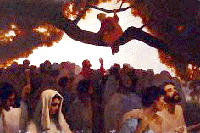
http://www.catholicireland.net/wp-content/uploads/1999/11/zacchaeus.jpg
1 And Jesus entered and passed through Jericho.
2 And, behold, there was a man named Zacchæus, which was the chief among the publicans, and he was rich.
3 And he sought to see Jesus who he was; and could not for the press, because he was little of stature.
4 And he ran before, and climbed up into a sycomore tree to see him: for he was to pass that way.
5 And when Jesus came to the place, he looked up, and saw him, and said unto him, Zacchæus, make haste, and come down; for to day I must abide at thy house.
6 And he made haste, and came down, and received him joyfully.
7 And when they saw it, they all murmured, saying, That he was gone to be guest with a man that is a sinner.
8 And Zacchæus stood, and said unto the Lord; Behold, Lord, the half of my goods I give to the poor; and if I have taken any thing from any man by false accusation, I restore him fourfold.
9 And Jesus said unto him, This day is salvation come to this house, forsomuch as he also is a son of Abraham.
10 For the Son of man is come to seek and to save that which was lost. (Luke 19:1-10)

A question I have asked myself about this story is, “Why did Zacchaeus get this personal attention from Christ?”  I have tried to imagine the situation and it seems to me that the measures he took to try to see Jesus made his faith obvious.

Think about it.  Zacchaeus was rich.  He probably dressed really well.  And when you dress in nice clothes, you tend to be careful about what you do in those clothes so that you can keep the clothes looking nice.  Do you climb trees in your best clothes?  Would you climb a tree in your prom dress or tuxedo?  Probably not.
Yet Zacchaeus was so eager to see Jesus that he was willing to climb a tree for it.  He didn’t care that it might wreck his clothes.  He didn’t care how silly it might look for a grown (and obviously wealthy) man to be sitting in a tree like a little kid.  He didn’t care what people thought of him.  (He was a tax collector, so he was probably used to being scorned by society.)  Up the tree he went.

So Jesus comes by and sees this well-dressed man sitting up in a tree.  He understands instantly that the man took no thought to clothes or dignity in his desire to have a good view.  He sees Zacchaeus has humility.  Humility in a wealthy man is priceless.  Humility is a wide open opportunity for sharing the gospel.  We can see now why Jesus wanted to spend time with Zacchaeus.

I suppose there are two different lessons from this part of the story.  Just as the Lord observed and responded to Zacchaeus’ humility, the Lord still observes and responds to our humility.  In this day of convenience, we show our faith and humility as we go out of our way to approach Him, when we do creative things to overcome the obstacles in our way or when we care more about coming to Christ than looking foolish.

Second, this lets us know how to appreciate others who go out of their way to lay hold on and stay faithful to the gospel.  The child of nonmember parents who comes to church or church activities by himself, the people who ask or knock or search in spite of risk of looking foolish or awkward, the people who cross the bounds of conventional behavior in order to satisfy their curiosity about the gospel, the teens who join the church and are disowned and thrown out of the house by their parents, the adults who give up dishonest employment to join the church—these people deserve special attention and nurturing as the Lord gave to Zacchaeus.  I have a boy in my cub scout bear den who fits one of the profiles I've described above, so this story teaches me to give him special care.

And Zacchæus stood, and said unto the Lord; Behold, Lord, the half of my goods I give to the poor; and if I have taken any thing from any man by false accusation, I restore him fourfold.”

How do we interpret Zacchaeus’ declaration in v8?  If it is a statement about what he hasn’t done but is going to do in the future, then this is a wonderful story of repentance. 

But what if Zacchaeus’s statement means that he has been doing this all along? (Note that it is in present tense, just like the Pharisee of the parable who proudly prayed in the temple a list of righteous things he did, which are also in present tense.)  If Zacchaeus was already doing these good things, then this story is about a person who has been unfairly judged and stereotyped by his community who gets a chance to set the record straight and be received into full fellowship in the rest of society.  It might also be a story about how stereotyping can lead to unfair judgments that cause shunning, meaning it was the crowd who had to repent, not Zacchaeus.  It might cause us to ask ourselves who is being marginalized in our communities or schools or wards whose faith and humility might actually surprise us if we truly knew them and gave them a chance.

Image: http://www.catholicireland.net/jesus-the-merciful-saviour/