Showing posts with label love. Show all posts
Friday, February 25, 2022 1 comments

A picture can affect our understanding of the scriptures

 One of my church callings that I've had for the last two years has been ward bulletin specialist. A small part of the calling that I particularly enjoy is the opportunity to choose the pictures and a scripture to go on the front of it.  I usually like to choose a scripture that fits with the theme of the meeting, but sometimes I don't know what the theme is, so I get to freestyle a little.

Sometimes I've found a picture and then searched for a scripture to match it. Sometimes I have a scripture in mind and I have to choose a picture to match it.  (Google images is not recommended, unless I can find an appropriate image free of copyright restrictions.)

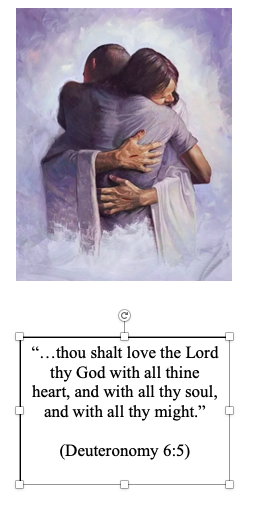
Something I've noticed is how the choice of picture can affect how I interpret the verse I choose. This particularly hit me this week. 

After putting that scripture with this image, I found myself staring at it. I felt my heart begin to yearn to embrace my Savior and my Heavenly Father. I also felt their love for me in a powerful way.  It seemed to me that commandment would be the easiest thing in the world to keep. 

 That verse of scripture lost all its abstraction and has became deep and tender. All because of a picture I paired with it.

Sunday, April 23, 2017 2 comments

All the Paths in Lehi’s Dream


28 And after they had tasted of the fruit they were ashamed, because of those that were scoffing at them; and they fell away into forbidden paths and were lost. . . .
31 And he also saw other multitudes feeling their way towards that great and spacious building.
32 And it came to pass that many were drowned in the depths of the fountain; and many were lost from his view, wandering in strange roads. (1 Nephi 8: 28, 31-32)

These verses stuck out to me recently. It was surprising to me to realize that there wasn’t just the strait and narrow path in Lehi’s dream. It wasn’t the only road in the field. There were forbidden paths (probably dangerous) and strange paths (strange probably in the sense of “foreign”).

We don’t know much about how Lehi knew those paths were forbidden or strange. Maybe it was one of those things that you just know in a dream without having to be told.

But all those people took those paths for some reason, thinking the paths would take them someplace they wanted.

1) People headed for the great and spacious building. Why? Because they wanted pride and to feel superior and to look down at and scorn people.

2) People who were at the tree and who were ashamed of partaking of the fruit wanted something else—approval of crowds?—more than the fruit, or love of God.

3) What about the people wandering in strange roads and forbidden paths? What was at the end of those roads that they wanted? We don’t know, but odds are it was something forbidden and strange, respectively.

Among all these different paths, there is the path to the tree of life (love of God). The people who got to the tree and stayed there did it because that’s what they wanted. 

In thinking about all these paths as representations of ways people take to get what they want, it has made me examine my motives and why I do what I do to keep the commandments. Do I do it because I know I should and that’s how I was taught? Yes. Do I do it because I love the Lord and want more of His love in my life? How strong a motive is my love of God and desire to receive His love?  For me I think it is subconscious. Truthfully, I think a bit more about God’s blessings than His love.  Perhaps that’s something I can work on.

So here’s a question to ponder today: what do you want most deep down, and what road are you taking to get it? Do you know why you want it? Whatever you and I want, we think it will make us happy. Will it?  Is God’s love involved?
Friday, April 21, 2017 2 comments

How Lehi Comes to the Tree of Life: A Faster Way?


10 And it came to pass that I beheld a tree, whose fruit was desirable to make one happy.
11 And it came to pass that I did go forth and partake of the fruit thereof; and I beheld that it was most sweet, above all that I ever before tasted. Yea, and I beheld that the fruit thereof was white, to exceed all the whiteness that I had ever seen. (1 Nephi 8:10-11)

I was reading through the account of Lehi’s dream of the tree of life, and I suddenly noticed Lehi’s method of getting to the tree is a bit different than the other ways he describes. He doesn’t notice a path or an iron rod. He sees the tree, knows what it offers to him, and he goes forth and partakes of the fruit. It is like he is so focused on it that there are no obstacles, no distractions in his way.

Then, when at the tree, he looks around and wants other people to have it too. Then he begins to see the obstacles and distractions that others deal with. In the case of his family, they don’t seem to know which way to go, so Lehi calls to them to get to the path, and some grab the path and the tree while others want the great and spacious building.

I wonder if this difference in methods tells us that there is a faster way to the tree (the love of God) than the path and the iron rod. It seems like Lehi’s focus on the tree—see, want, get—gets him there faster. It reminds me of some stories of converts who as soon as they hear, they accept, act, and are blessed.  There have been a few gospel principles that I have adopted into my life that way. Others I have had to be convinced of over time through scripture study and my own experience and experimenting on the word.

So, I have to ask myself, do I see an offer of God’s love for me? Do I act to lay hold on it, or am I brought to the love of God through obedience and scripture study? I think I’ve been brought to it more gradually, but noticing this in Lehi’s dream shows me I could try looking for God’s love being offered me and act to respond.

Friday, March 24, 2017 0 comments

Symbols of the Love of God


And it came to pass that I beheld that the rod of iron, which my father had seen, was the word of God, which led to the fountain of living waters, or to the tree of life; which waters are a representation of the love of God; and I also beheld that the tree of life was a representation of the love of God. (1 Nephi 11:25)

I was struck by this recently. This is during Nephi’s vision of the tree of life and the dream his father had.

I noticed that it wasn’t just a tree representing the love of God in this vision, but also a fountain of living waters. So I asked myself why both were there. What is it about a fountain and a tree that God wanted to use them both to represent His love?

A fountain flows and overflows continuously. And a tree grows and produces flowers and fruit.  There is motion and life and results from them.  That tells us something about the love of God. It’s active and it grows and it produces results/ fruits. 

I suppose that might be a good guide for what we can look for in our lives.  It also shows us how our love needs to be for our spouse, for our children, for people around us, and especially for God.

Can we say our love is flowing and overflowing and growing and fruiting?

Friday, October 14, 2016 0 comments

Lehi’s Dream: Three Tools of Satan, Three Tools of God

-->
16 And the angel spake unto me, saying: Behold the fountain of filthy water which thy father saw; yea, even the river of which he spake; and the depths thereof are the depths of hell.

17 And the mists of darkness are the temptations of the devil, which blindeth the eyes, and hardeneth the hearts of the children of men, and leadeth them away into broad roads, that they perish and are lost.
18 And the large and spacious building, which thy father saw, is vain imaginations and the pride of the children of men. And a great and a terrible gulf divideth them; yea, even the word of the justice of the Eternal God…. (1 Nephi 12:16-18)

I notice that in Lehi’s dream (or as it is interpreted to Nephi by the angel), there are three elements that Satan uses as his tools.

1) The filthy river of water.  This is not a clear river. It’s carrying a ton of silt. I think the river can express sinfulness that is immersive and addicting, the kinds of sins that can make one think everything is dirty.  It is aptly described as the depths of hell.  This is not the kind of river a person can just wade in a little and walk out of. It’s worse than quicksand. It’s called “the depths of hell” for a reason.

2) The mists of darkness. Mists are nebulous and insubstantial, but they make things look different and hazy. I think mists are a great way to express how Satan’s temptations mess with our perceptions and try to make us think that things are different than what they really are.

3) The large and spacious building. Manmade, yet unstable, since it eventually falls. It looks like it would provide shelter from the elements, like it would be comfortable. But it is inherently unsafe. (I have to wonder if we make our own great and spacious buildings.) It looks like it would be a better, more interesting destination than that tree over there. A fancy-but-unsafe building is an excellent symbol for pride. Also, the way it gathers a judgmental, scornful crowd captures pride’s workings in larger society. Even if it feels like it is safe to go with the crowd, wrong is still wrong, and eventually it will be proven so.

So, we’re not just to beware of the mists of temptation, but also pride and filthiness.

Compare these things to the instruments of God, which are the path, the rod, and the tree with its fruit.

1) The path.  It’s the only safe way with sure footing and a desirable destination. There aren’t rocks or obstacles or holes in it. (Only Satan tries to make us think there are.) To me the way we walk in the path teaches that God gives us things to do that help us progress.

2) The rod. It’s a fail-safe for the path and works in tandem with it.  If you can’t see the way to go, you can feel it through the rod. For every place you are on the path, there is rod there to guide you.  Also, anyone who honestly grabs and holds the rod will get on the path.  The rod is guidance that God gives us through revelation and the scriptures. 

3) The fruit. The fruit seems to me to be both the goal and nourishment along the way.  God’s love nourishes us with sweet tastes that point us to a future hope of exalted bliss, and isn’t the fullness is also the reward?  (This is perhaps the place where it seems like the dream breaks down for me as an allegory.)

So, I see that God uses gospel progression, revelation, and love as His tools during this life.

If we can just choose more of God’s tools and reject Satan’s tools!
Thursday, July 14, 2016 0 comments

Thoughts on President Eyring’s April 2016 talk :Where Two or Three Are Gathered

When I read through President Eyring’s talk “Where Two orThree Are Gathered,” my heart went out to the two individuals whose problem he described of wanting to feel nearer to God:

I know of at least two people listening today who want that blessing with all their hearts. They will try earnestly to draw nearer to the Lord during this conference. They each wrote to me—their letters arriving at my office in the same week—pleading for the same kind of help.
Both of them are converts to the Church and have previously received clear testimonies of the love of God the Father and of His Son, Jesus Christ, the Savior of the world. They knew that the Prophet Joseph Smith organized the Church by direct revelation from God and that the keys of the holy priesthood were restored. Each felt a witness that keys are in place in the Church today. They bore to me their solemn testimony in writing.
Yet both lamented that feelings of love for the Lord and His love for them were lessening. They both wanted, with full heart, for me to help them regain the joy and the feeling of being loved that was theirs as they came into the kingdom of God. Both expressed a fear that if they could not regain in full those feelings of love for the Savior and His Church, the trials and tests they faced would finally overcome their faith.
They are not alone in their concern, nor is their test a new one.

I noticed that President Eyring’s talk is full of helpful doctrine and admonitions for those who might be going through this same difficulty.

Note that he says they are not alone in their concern and their test isn’t a new one.  I would almost say the problem is endemic to the fallen mortal condition. We are prone to wander and leave the God we love. Even as members of the church we are still liable to relax and forget the Lord.  And on top of that, we have the challenges of mortality, as President Eyring lists elsewhere in his talk:

All of us have had our faith tested by precious blessings delayed, vicious attacks of those who wanted to destroy our faith, temptations to sin, and selfish interests that reduced our efforts to cultivate and soften the spiritual depths of our hearts.

--Blessings delayed (These can make us feel forgotten by God. Our resentment can rise and it takes faith and patience to overcome this.)
--Vicious attacks (These can make us feel unsupported by God. We want God prove we are right or defend us. Or we might wonder where we can find answers to sudden questions.  It takes courage and trust and patience to overcome this.)
--Temptations (These can make us feel like God’s way is unattractive or not enticing. It takes trust and the capacity to sacrificially mortify the flesh to overcome this.)
--selfish interests  (These can make us feel like God doesn’t want us to have our way or that He doesn’t care about our individuality. It takes humility and sacrifice to overcome this.)

Probably the main point President Erying wanted to make about how we can overcome the tendency to stray and lose our connection to our Heavenly Father comes even before he mentions the problem:

Where and when we feel the closeness of the Savior depend on each of us. He gave this instruction:
“And again, verily I say unto you, my friends, I leave these sayings with you to ponder in your hearts, with this commandment which I give unto you, that ye shall call upon me while I am near—
“Draw near unto me and I will draw near unto you; seek me diligently and ye shall find me; ask, and ye shall receive; knock, and it shall be opened unto you” (D&C 88:62–63).

President Eyring included a quotation from Christ’s parable of the sower about the four different types of ground receiving seed. The seed is the same; it is the ground that is ready to receive it or not.  Likewise, the word is the same, it is our hearts that are ready to receive it or not.

What I really liked was that in his talk he outlined some very quick and immediate steps that everyone could take during conference to soften our hearts and receive and nourish the word.  He suggested we pray throughout conference:
--Pray with those who are praying
--Pray as a speaker approaches the pulpit to receive the Spirit of truth
--Pray as the choir is about to sing
--As speakers are about to end talks, pray that God would give them of right words of testimony to lift everyone

I remember when he suggested this I was very touched, and I tried to do that throughout conference. It did help me feel increased closeness to God.  It also helped me pay extra attention to the speakers’ ending testimonies, and I appreciated them much more than I had done before.

I learned through this experience how important prayer is to increasing our closeness to God.  I extrapolate that this practice of personal, silent prayer can be used not just during general conference, but at all our church meetings as well.

But prayer isn’t the only way that we can do our part to draw near to the Lord. While I was reading this talk, I ended up making a quick list of things I have found help me draw nearer to the Lord:
--Taking the sacrament
--Remembering Christ at various times and places
--Daily scripture study
--Diligent service to others
--Temple worship
--Fasting

Drawing closer to God takes effort on our part. We can’t just drift and wish He were closer. We have to take action and move closer ourselves.

At a very young age (in late elementary school) I noticed the pride cycle pattern in my life, though I didn’t know enough to call it that. I noticed that after a period of trying hard to be good, I would start slacking off and then my spiritual life would go downhill.  With that slacking off would come a feeling of apathy that made church activity annoying.  I didn’t like being in that spiritual condition. 

Each time I noticed this, I had to make a choice to try to live right again.  When I did, I felt closer to the Lord, I felt I was progressing, I felt better about life, I felt happier.

As I got older, this cycle continued in my life, and I began to look for ways to avoid falling into the negative part of the cycle.  When I was in high school, I stumbled across a scripture that said “Weary not in well-doing” and I knew that was the key to escaping the pride cycle and staying on the good side.

President Eyring says something really insightful about our condition when we notice we’re feeling distanced from the Lord:

Those who are saddened by the loss of the joy they once had are the blessed ones. Some do not see the withering of faith within themselves. Satan is clever. He tells those he wishes to be miserable that the joy they once felt was childish self-delusion.

Satan tries to make us think that losing that closeness to God is irreversible. Or he tries to make us think that we’re progressing beyond the need for it.  Both of those messages are lies.

If we notice we’ve lost what we once had, we’re blessed because seeing the problem is the first step toward fixing it.  But to fix it, we have to do our part seeking after the Lord.

We’re more in trouble if we don’t see our own faith withering or if we think we’ve outgrown faith or joy from the gospel. 
1)   The only way we outgrow faith is if we know for certain the truth of the things we once simply believed. 
2)   Since the eternal destiny of Heavenly Father’s righteous children is eternal joy, it is not possible to outgrow joy.  A fullness of joy is our coveted end, not a temporary waystation.  There is nothing childish or self-delusive about true joy.

This talk has been a good reminder for me how much I need prayer in addition to the other practices for drawing closer to God.


Suggestions for teaching:

Read class members the account of the two members writing letters to President Eyring.  Ask them if they have ever gone through that kind of challenge.  Ask them what they would advise those two members if they had been in President Eyring’s position.

Ask class members to brainstorm lies that Satan tells us about our lessening feelings of love from the Lord.  What is false about those thoughts, and what is the truth?

Ask class members what life experiences or circumstances have challenged their faith or made it more difficult for them to feel the love of the Lord in their lives.

Have class members look up the scriptures that Elder Eyring quoted in his talk. What do those scriptures teach that can help with the problem of feeling distanced from the Lord and His love?

Ask class members to share what things they do that help them draw closer to the Lord.  How do these things help?

Ask class members if they followed President Eyring’s counsel to pray for those speaking, singing, praying, or testifying in conference.  Ask them to share what they felt when they did.  Challenge them to try praying at other church meetings similarly.
Thursday, October 22, 2015 0 comments

Alma on unity among church members


I really like what is recorded about how Alma the elder taught about unity among the church when they still lived among King Noah’s people.

And he commanded them that there should be no contention one with another, but that they should look forward with one eye, having one faith and one baptism, having their hearts knit together in unity and in love one towards another. (Mosiah 18:21)

Two bits of imagery stick out to me in these verses—the idea of hearts being knit together in love and looking forward with one eye—so I want to share some things I associate with both of those.

Hearts knit together in unity and love

I think of two different things here.  I think  of how a broken bone is knit together. It is put right, and it is held there and protected from outside collisions until it is strong.  Then it can stand up to forces put on it.  I think that gradual growth together is a beautiful analogue to how unity grows gradually.

I also think of yarn that is strung out and apart and it may get easily tangled until it is knit together. Perhaps sharp things would cut it when loose, but it has more strength and flexibility when knit into a fabric.  Even if there is a cut in one place in a knit, it doesn’t fall apart.  The yarn loop connects with other loops around it in different places and draws shape and strength from those touch-points.

Looking forward with one eye

I was very young when I discovered that there was a slight difference in how things looked depending on whether I looked with my right eye or with my left. I marveled that when I held a finger in front of me and looked at it with one eye closed and then with the other, the position of my finger seemed to shift slightly.  This fascinated me and when I got bored or distracted sometimes I would play with it.  It wasn’t until I took astronomy in high school that I learned a term for this phenomenon—parallax—and that it enabled telescopes to see deeply into space and establish distances. 

When I got older than that, I realized that there can also be spiritual parallax between individuals because of difference of perspective.  We may look at the same events and see things differently.

I think “looking forward with one eye” expresses the prophet’s hope that we can come to unity by adopting the Lord’s perspective.  Remembering the plan of salvation helps us see with a more eternal perspective, so that’s part of how the Lord sees things.  We learn to see with one eye when we teach and learn correct principles and pattern our lives after them.  I think we also learn to see with one eye when we learn how principles that seem to oppose actually mesh and interplay and balance each other—prophetic authority with personal revelation, foreordination with agency, justice with mercy, self-reliance with dependence on God and interdependence with others.

Do you have an additional thoughts or associations with these phrases that you can share?

Saturday, August 29, 2015 0 comments

The breakdown of family in ancient Egypt


22 And it came to pass when I was come near to enter into Egypt, the Lord said unto me: Behold, Sarai, thy wife, is a very fair woman to look upon;
23 Therefore it shall come to pass, when the Egyptians shall see her, they will say—She is his wife; and they will kill you, but they will save her alive; therefore see that ye do on this wise:
24 Let her say unto the Egyptians, she is thy sister, and thy soul shall live.
25 And it came to pass that I, Abraham, told Sarai, my wife, all that the Lord had said unto me—Therefore say unto them, I pray thee, thou art my sister, that it may be well with me for thy sake, and my soul shall live because of thee. (Abraham 2:22-25)

I’ve written about this incident several times I think, but this last time when I came across it I was struck by how this danger to Abraham indicated a breakdown of family in Egyptian society.  It was a society in which those with power were not honoring others’ marriages, but breaking them up by killing one spouse to free the other to marry again, to marry the power player who wanted them.  (I have to wonder if this was a different kind of family breakdown, or the same family breakdown, just further along the path to destruction.)

It is interesting to me that Sarai’s beauty was notable, but Abraham’s looks are never mentioned.  It makes me think that perhaps Abraham was rather plain. And if so, that means Sarai married him because she was able to look below the surface to see his goodness, and she cared more about his good character than marrying someone with good looks.  And the fact that he (a righteous man) chose her too shows that he knew she was a good woman, not just a pretty face.

In contrast to Sarai and Abraham’s relationship that valued character, the Egyptians were really shallow, valuing Sarai only for her looks and for nothing else.  I have to wonder if they thought only good-looking men deserved beautiful women, or whether they thought only Egyptians with sufficient force were allowed to have beautiful women. 

Also, the Egyptians seem to have been hanging on to some semblance of marriage permanence; you can tell at bottom they believed it should last until death, but their society had been corrupted to the point that they were willing to hurry death up to free a beautiful woman from her inconvenient husband.  This is pretty barbaric, and I don’t think that started all at once, but with a gradual slide—obsession with the sensual, loss of emphasis on character, focusing too much on outer appearance, indulgence of desire, and law winking at those taking license.   

The fact that the Lord warned Abraham of the danger and told him how they could protect themselves is very reassuring.  It shows the Lord really does know how to protect marriages and families, and He gives instructions designed for the circumstances.  

 It also struck me recently that the instruction to say that Sarai was his sister may have just seemed like a ruse to protect from the physical danger, but it was actually a spiritual safeguard as well, an important principle for relationships that can actually help men and women keep from falling into the error of objectifying the opposite sex. 

Seeing and treating someone as a brother or sister takes you back to the most basic ways of relating, that of sibling relationships.  Everything about learning to be close and learning to love is there except for the sexual aspect.  (And I’m assuming that those reading have learned to love their siblings and know what I am talking about.)

Perhaps if we find ourselves getting pulled into an objectifying pattern of thinking, we need to practice the sibling frame of reference for a while.  Take a page from Abraham’s experience and say, “She is my sister.”  Or learn from Sarai’s patience with that difficult situation and say, “He is my brother.”  In the church, we do this naturally among those we are not related to; we call each other Sister Johnson or Sister Emily or Brother Clark or Brother Bruce.  We realize we are all brothers and sisters, children of God.  That awareness of the brotherhood and sisterhood of all of us can also help us in our relationships and marriages, though we don’t have to necessarily call each other brother and sister.

 During the time that Abraham and Sarai treated each other as brother and sister, they were an example to the Egyptians. There came a time when it was safe to reveal they were married, and if the Egyptians thought back over how Abraham and Sarai had interacted, they would see how a good marriage is about more than looks and sex. Maybe Abraham and Sarai became instruments in helping improve Egyptian marriage culture through their good example, since examples are the best way to catch the vision of what improvement is possible.

Maybe our good examples of marriage can help today too.
Sunday, July 19, 2015 0 comments

How we abide in God’s love


This is Christ speaking to his disciples in the upper room at the time that he also instituted the sacrament.
If ye keep my commandments,
ye shall abide in my love;
even as I have kept my Father’s commandments,
and abide in his love.
(John 15:10)
Christ and the Father may love us unconditionally, but for us to feel that and know it, we have to keep the commandments.  If we don’t keep the commandments, we disconnect ourselves from that love, as if a light were to disconnect itself from the electrical socket.  The electricity is still available, it is just not flowing through the light.

I love this scripture and the truth it contains.

Today let’s try a little harder to keep the commandments so that we can feel that love.

Wednesday, April 29, 2015 0 comments

To whom little is forgiven, the same loveth little


You’re probably familiar with the story in Luke 7:36-48 of Jesus at the Pharisee’s house with the woman who came and wiped His feet with her hair and anointed them with ointment.  When the Pharisee looked down on the woman for her demonstrative love and because she was a sinner, Jesus told the parable of the two debtors, one owing five hundred pence and the other owing fifty, which a creditor forgave.  He asked the Pharisee which debtor would love the creditor the most for that, and the answer was of course, “he, to whom he forgave the most.”

Now we come to the punchline that hit me different recently.

44 And he [Jesus] turned to the woman, and said unto Simon, Seest thou this woman? I entered into thine house, thou gavest me no water for my feet: but she hath washed my feet with tears, and wiped them with the hairs of her head.
45 Thou gavest me no kiss: but this woman since the time I came in hath not ceased to kiss my feet.
46 My head with oil thou didst not anoint: but this woman hath anointed my feet with ointment.
47 Wherefore I say unto thee, Her sins, which are many, are forgiven; for she loved much: but to whom little is forgiven, the same loveth little.
48 And he said unto her, Thy sins are forgiven. (Luke 7:36-48, emphasis added)

Previously I thought Jesus was just saying that Simon (the Pharisee) didn’t have very many sins to be forgiven of and that meant he didn’t love Jesus as much.

But recently I realized that Jesus didn’t say anything about how many sins Simon had; we just assume it was fewer because of the comparable sizes of the debts in the parable.   Also, it doesn’t say anything about whether Jesus forgave Simon or not; we just assume He did because of the parable.

I suspect that Simon had begun to repent, but that he hadn’t finished yet.  And because he was not finished, I think he still probably viewed faith in Jesus to repentance as a sort of last-resort tool or something to not be used very often.  Because he hadn’t used it much, he wasn’t as grateful as the woman, who had some serious sins that had been forgiven her.

Now here’s a question you may have had about this parable, even if only subconsciously.  (I know I had it myself.)  We may wonder, “If I haven’t committed huge sins, does that mean I am doomed to love Jesus less?” 

We don’t want to go the route of committing big sins just to repent so we can love Jesus more.  Sin is still sin; it still alienates us from the Lord.

The solution is that we gain greater appreciation for Christ’s atonement over time as we use it in our lives.   

When I was a teen, I knew about the atonement in theory, but I still had this foolish idea that I could do things myself.  Naturally, I didn’t appreciate the atonement much.   But as I came to points where I had to experience it and use it, I came to appreciate it more. 

Now, as I look back over the sins and mistakes that I’ve made and been forgiven of, as well as the weaknesses that I’ve asked for enabling power to cope with, I have a much greater appreciation and gratitude for it.   (I also sense that my gratitude is much smaller than it should be.)  But I imagine that my gratitude will only grow the more I use it in my life until the day I die when I will testify it was the only way I made it.


Saturday, February 14, 2015 2 comments

Some scriptures for Valentine’s Day


As we celebrate Valentine's Day, I thought it would be nice to gather some scriptures about what the prophets have written about love over the centuries. These things help give perspective.

A new commandment I give unto you, That ye love one another; as I have loved you, that ye also love one another. (John 13:34)

I know thy heart, and have heard thy prayers concerning thy brethren. Be not partial towards them in love above many others, but let thy love be for them as for thyself; and let thy love abound unto all men, and unto all who love my name. (D&C 112:11)

2 By this we know that we love the children of God, when we love God, and keep his commandments.
3 For this is the love of God, that we keep his commandments: and his commandments are not grievous. (1 John 5:2-3)

Love worketh no ill to his neighbour: therefore love is the fulfilling of the law. (Romans 13:10)

Love not the world, neither the things that are in the world. If any man love the world, the love of the Father is not in him. (1 John 2:15)

For if ye love them which love you, what thank have ye? for sinners also love those that love them. (Luke 6:32)

There is no fear in love; but perfect love casteth out fear: because fear hath torment. He that feareth is not made perfect in love. (1 John 4:18)


Happy Valentine's Day!
Thursday, January 8, 2015 0 comments

Jesus on Divorce Causing Adultery

This is a verse I’ve always puzzled over:

Whosoever putteth away his wife, and marrieth another, committeth adultery: and whosoever marrieth her that is put away from her husband committeth adultery. (Luke 16:18)

The thing that bothered me before was I couldn’t understand how divorced people could ever be able to marry again and find happiness if any man who marries a divorced woman has committed adultery.

Finally it hit me that Jesus is describing a situation with certain preconditions that may or may not be true in our modern age of increased mobility.

In Jesus’s day, people stayed in the same place and hardly ever moved far from their ancestral home.  People knew everyone in their locale.  We are also to remember His previous pronouncement in the Beattitudes that he who looks on a woman to lust after her has committed adultery already in his heart. 

So, the man who puts away his wife and then marries another woman immediately after has been looking and lusting after that second woman who lives in the same locale.  The second marriage is essentially legalized adultery.

Likewise, the man who pretty quickly marries the woman who was divorced is one who knows her and has been looking and lusting after her all the time she was married to the other guy.  His marriage to her is legalized adultery as well.

The principle Jesus was teaching was you don’t look around and people in your community and pick out who you would marry if you or they were unattached.  And singles aren’t supposed to pick out potential spouses from people who are married.  And if the way seems to open to do something about it, to act on any ideas you’ve had of that nature is adultery, even if it is legalized, because God knows what has been happening in our hearts.  That kind of thing does not stop if the itch is scratched.  It will itch again.

Now, having established this, we can see then that if two singles meet, want to marry each other, and find out that one or both of them have been divorced before, then that is not adultery because there is no history of them knowing and wanting each other while married to other people. 

Now, let us examine another version of this.

But I say unto you, That whosoever shall put away his wife, saving for the cause of fornication, causeth her to commit adultery: and whosoever shall marry her that is divorced committeth adultery.  (Matt. 5:32)

This is also puzzling,  the part about how woman who are put away for any cause besides fornication are being forced to commit adultery.   How does that happen? 

I suspect this goes back to the idea of looking and lusting.  Women are not visually stimulated like men, but after being rejected and divorced for a lesser cause than fornication, they might find themselves looking at other relationships around them, looking at the men and wondering if that man or that man would have treated them better than their ex had, wondering what it would have been like to marry one of them instead.     The way women are so relationship-oriented, Jesus implies that those kinds of thoughts are practically inevitable in a frivolous divorce, to the extent that He declares that the ex-husband is to blame for it.  That’s a pretty heavy condemnation, I’d say, especially since this verse comes in the middle of a lot of commandments about guarding thoughts.

Understanding these verses really teach how important mental loyalty is in marriage. They no longer seem unreasonable or nonsensical, but instead are plain in requiring purity of thought.


Tuesday, August 26, 2014 0 comments

The Divine Sign that Wanting a King was Bad

-->
After King Saul was anointing king, after he had already led the people to great victory over the Amorites, Samuel has the people come to Gilgal where they renew the kingdom.  Samuel challenges the people to tell him of any injustice he has done and they can’t come up with anything, which exonerates him as a judge.  He also reminds them of the great things God had done for them and their ancestors and he warns them that although they have what they wanted –a king—they have to remember to keep the commandments.

Then Samuel does something rather unusual. 

16 ¶Now therefore stand and see this great thing, which the Lord will do before your eyes.
17 Is it not wheat harvest to day? I will call unto the Lord, and he shall send thunder and rain; that ye may perceive and see that your wickedness is great, which ye have done in the sight of the Lord, in asking you a king.
18 So Samuel called unto the Lord; and the Lord sent thunder and rain that day: and all the people greatly feared the Lord and Samuel.
19 And all the people said unto Samuel, Pray for thy servants unto the Lord thy God, that we die not: for we have added unto all our sins this evil, to ask us a king.
20 ¶And Samuel said unto the people, Fear not: ye have done all this wickedness: yet turn not aside from following the Lord, but serve the Lord with all your heart;
21 And turn ye not aside: for then should ye go after vain things, which cannot profit nor deliver; for they are vain.
22 For the Lord will not forsake his people for his great name’s sake: because it hath pleased the Lord to make you his people. (1 Sam. 12:16-22)

Samuel declares a sign the Lord will do to show them Israel’s wickedness was great in asking for a king.  The sign is that Samuel will pray for the Lord to send thunder and rain in the middle of the wheat harvest that day.  (As a reader I get the impression that in the natural course of things it was unlikely for it to rain at that time of year, so that would be an effective sign.)

The sign happens as Samuel said, and all the people realize their wickedness and begin pleading with Samuel to intercede for them to God so that they wouldn’t die for adding this national sin to their individual sins.

Samuel reminds them to keep following the Lord and serve with all their hearts and assures them that the Lord would not forsake them for his own name’s sake.

The question that came to me as I was reading this was, “Why does the Lord give them this sign now once they already have a king and can’t get rid of him?  Wouldn’t it have been better to give it before they had a king?”

I have several thoughts about this.  First I recall the principle that signs follow those that believe and that signs can condemn the unbeliever.  It may be that if the sign had been given in addition to the arguments against having a king it would have condemned the Israelites if they had continued to go against it.

To give the sign afterward reinforced the message of “wanting a king is bad” to show that just because the Lord gave them a good man for a king and just because the king had helped them STILL did not mean that the Lord had changed His stance that wanting a king was bad.

The sign also demonstrates that even if the people thought Samuel was going to take a backseat to Saul’s leadership, Samuel continues to speak for the Lord.  Samuel is still a prophet and he’s not going away just because Saul is a king chosen by God.

This is going to sound obvious, but the most important thing the sign demonstrates to the people is that they have all sinned, so it becomes a dramatic call to repentance.  You can see that they instantly feel the need and they ask Samuel to intercede for them to God.  (This makes Samuel a type of Christ here.)   Yet while the sign shows the people their estrangement from God, it also demonstrates that God has not given up on them.  If God had forsaken them, He would not take the trouble to tell them where they had sinned.  Samuel reminds them of this.  “For the Lord will not forsake his people for his great name’s sake: because it hath pleased the Lord to make you his people” (v22).

I hope I can see the signs I have sinned before it comes to dramatic displays of thunder and rain.  One of the easiest ways is to listen to conscience and read the scriptures.

Another thing this shows us is that switching leaders or government systems doesn’t negate the commandments of God.  In the church, if we think we need new leaders it is usually because we are the sinful ones.  Our disobedience isn’t changed by a change of leaders.  Sin is the problem.

You can also see that Samuel has an understanding of the perfect love of God when he says, “The Lord will not forsake his people for his great name’s sake.”  God doesn’t stick with Israel because of anything Israel has done to deserve it; Israel may be humble enough to answer the call, but Israel is prone to wander.  God sticks with Israel to show His unfailing love.  It is who He is. 

It’s taken a long time for me to learn that.  And like Israel, who is prone to wander, so I also forget it from time to time and begin to worry that this time I have gone too far and the Lord will hold a grudge against me if I try to repent, like some people I’ve known.  And then somehow the Lord shows me that He is more willing to forgive than I give Him credit for.  That gives me the courage to repent and try again and again and again.