Showing posts with label study. Show all posts
Friday, February 25, 2022 1 comments

A picture can affect our understanding of the scriptures

 One of my church callings that I've had for the last two years has been ward bulletin specialist. A small part of the calling that I particularly enjoy is the opportunity to choose the pictures and a scripture to go on the front of it.  I usually like to choose a scripture that fits with the theme of the meeting, but sometimes I don't know what the theme is, so I get to freestyle a little.

Sometimes I've found a picture and then searched for a scripture to match it. Sometimes I have a scripture in mind and I have to choose a picture to match it.  (Google images is not recommended, unless I can find an appropriate image free of copyright restrictions.)

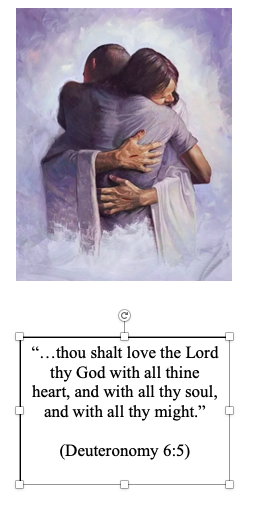
Something I've noticed is how the choice of picture can affect how I interpret the verse I choose. This particularly hit me this week. 

After putting that scripture with this image, I found myself staring at it. I felt my heart begin to yearn to embrace my Savior and my Heavenly Father. I also felt their love for me in a powerful way.  It seemed to me that commandment would be the easiest thing in the world to keep. 

 That verse of scripture lost all its abstraction and has became deep and tender. All because of a picture I paired with it.

Saturday, February 8, 2020 1 comments

Review: The ScriptureNotes Web Application is a Powerful, Flexible, Study Tool


The Gospel Library app has some good marking and notation tools, but for a long time I’ve felt its search tools left a lot to be desired. My ipad had a scripture study app that had a pretty good search tool, but its note-taking features frustrated me.


Today I’m happy to tell you about a better scripture study tool. It’s called Scripturenotes. 


If you want to see this tool in action, you can go here [https://scripturenotes.com] to see a video example of it being used. When I watched it, I instantly could see its potential and how it could jumpstart my scripture study, which has been in a bit of a dull place lately.


It's very powerful.

  • I can do a search for a word or phrase in the scriptures, then can sort through the search results and eliminate results that aren’t applicable.
  • Then, I can create a collection of a curated set of search results, and then make notes on each verse and add different markings to those verses.
  • The application provides places to make summarizing statements about the whole collection and what was learned from it.
  • It allows me to bold, underline, highlight text, even create my own footnotes. [Can I just say how excited I am to be allowed to create my own footnotes?]
  • Another thing about this application that is amazing to me is that it seems like you can just start new search windows endlessly. You can go down a scripture research rabbit hole and follow it as far as you want and not have to worry about losing where you are with everything else.
  • And charts! You can add tables to a Master note and then populate it with verses to compare and contrast with each other!
  • You can put all kinds of other things in those Master notes: pictures, links, inspiring youtube videos! This makes it incredibly flexible.


The way that it can give room for each verse to have its own notes is another exciting thing. Just looking at that, I could see that if I’d had that in 2018 when I was doing the very first drafting of my Revelation Commentary (a project I’m working on revisions for, by the way,) I would probably have made a lot more progress right away.


I have another writing project on a scriptural topic that will probably have new life breathed into it because of this application! 


How is it on the internet? It depends on your connection. IF you have a fast connection, this should be pretty quick. If your connection is slower, it may go slower.


Can you save your notes that you make on this app? Yes. Creating a collection enables your notes to be saved in the application, and if you want to have a hard copy, you can print a collection of scriptures, along with the notes and markings you’ve made.


Now, with all of this, you may be wondering if there are any problems with this application. Would I change anything about it if I could? 

I have three little quibbles:

1)    It is hard to remember what some of the icons mean that are to the side of the verses. I kind of wish they had directions that appear when the mouse rolls over them. (However, this becomes less of an issue the more one uses the application.) [Edit: This issue has been fixed.]

2)    It would be nice if collection notes saved themselves automatically without having to push the Update button.

3)    Collection notes have a hard time handling large numbers of search results. It was choking over 300+ results, so I had to eliminate some of the search results before I could make a collection. It would be nice if they could just take whatever is thrown at them. [Edit: I've been told this cap is temporary and the current work-around is to make several collection notes and then sort search results into those various collection notes by using the 'drag-and-drop' button]

That being said, it seems like this application is really well-designed.


Now, how much does this application cost?


This is a subscription application, and use of the app costs $49.95/year. This works out to $4.16 per month, or about 14 cents a day. This powerful search tool is probably worth that because of how easy it will make it to drill down into search results and record thoughts and impressions about what you find.  Think of it this way: would you pay 14 cents a day for a tool if you knew that just 15 minutes using it would enable you to learn something new about the gospel?  Flecks of gold, people, flecks of gold…


All in all, this is a very powerful and flexible scripture study web application, and I highly recommend it.


Disclosure of Material Connection: This is a “sponsored post.” The company who sponsored it compensated me via something of value to write it. Regardless, I only recommend products or services I believe will be good for my readers. I am disclosing this in accordance with the Federal Trade Commission’s 16 CFR, Part 255: “Guides Concerning the Use of Endorsements and Testimonials in Advertising.”
Friday, October 11, 2019 0 comments

Some things I've learned from the Book of Revelation

I'm still working on my book about the Book of Revelation. I finished a draft about two weeks ago (yay!), and yesterday I got feedback about my Introduction in which I try to explain why that book is so important to understand. This test reader found my explanation needed some work. (Doh!)

So of course I went to work trying to improve it.  Eventually I realized I had a tangle of half-articulated reasons.  Which means I had to un-tangle and fully articulate.

 But it just wouldn't come. There was just so many ways that I realized the Book of Revelation can help us.  And as I worked away at it, adding here, moving there, over and over... I discovered a lot of the reasons interlocked with each other and led to more reasons. That made it really hard to tell how to organize my paragraphs.

So I gave up on the writing part for a while and decided to mind-map it out.  I hoped that I could at least begin to see the relationships better than I did before.

Here's what I have so far.  Hopefully you can click on this thing and read my tiny print. :-)


Naturally, not every single bubble will find its way into the particular section I'm working on. But at least I'll be able to see relationships better.

Friday, August 2, 2019 0 comments

Nifty New Resource: The Scriptures, Mapped


If you’re having troubles getting an idea of where the stories happen in the Old and New Testaments, have a look at this new online resource called The Scriptures, Mapped.

Suppose you’re reading in Acts 20 and aren’t sure where Troas or Philippi are in verses 5-6. You can go to this resource, find Acts 20, and click on the highlighted names and it will show you on the map where they are.  In fact, when you open Acts 20, you can see on the map all the locations that are named in that chapter.

So. Cool.
Sunday, March 5, 2017 0 comments

Unfolding the Scriptures


And they shall give heed to that which is written, and pretend to no other revelation; and they shall pray always that I may unfold the same to their understanding. (D&C 32:4)

This was part of a section given to Parley P. Pratt and Ziba Peterson along with directions to go on a mission to preach to the Lamanites.

I really love what this verse says to them with reference to the scriptures. In another place in the D&C we are directed to “pray always that ye may come off conqueror, yea, that ye may conquer Satan,” and here it says “pray always that I may unfold the same [scriptures] to [your] understanding.”  So, that tells us that not only is constant prayer vital for resisting temptation, but also for receiving understanding about the scriptures. I have found that whenever I pray prior to reading, the Lord opens my eyes that I see and notice something I hadn’t before.

I also love that the Lord uses that imagery of “unfolding” to describe increased understanding. When something is folded, it’s very compact and looks simple. But when it is unfolded, it gets bigger and there is more to it. It begins to become complex, like discovering a new wing to a building.

And here’s the thing—we don’t know how many times things can be unfolded further. Just because a principle has been unfolded once doesn’t mean there isn’t more to be unfolded. I’ve noticed I’ve commented on some scripture passages multiple times because I keep getting more out of it over time.

Yay for scriptures, and yay for personal revelation through prayer!
Thursday, December 15, 2016 0 comments

Creating a Psychological Survival and Coping Kit


I grew up as a pretty happy-go-lucky person.  Somehow I learned to see the importance of making a decision to be happy and look on the bright side of things, and that made a lot of things easier for me.

But I still had trials and tests.

And afflictions.

And weaknesses.

And transgressions that I fell into.

At one point, I fell into a depression, and I got some counseling.  Under the direction of a doctor, I tried a few medications, but had more difficulty from the side-effects than from the depression.

Happily, my counselor at the time recommended a book to me called Feeling Good, by David Burns.  I got the book and read it.  In it, I found that much of my depression at that time was being caused by the way I was thinking.*  The thoughts were causing depressive feelings and contributing to a hopeless view of the world.

Eventually I learned that I had gotten cultivated some non-productive thought patterns that caused me pain.   (I’m sure Satan found that most amusing.)

I learned things about:
--How to have more realistic expectations of myself (and others)
--How to tell where my responsibility ended and another person’s began
--How to think more productively about what I did so that I could feel greater joy and happiness.

I don’t mind telling you that there were also things I read in Feeling Good that seemed to clash with gospel principles.  I was tempted to reject them because of that. But there was so much there that was helpful that I considered it a very valuable book, one worth keeping and referring back to from time to time.  I knew enough about myself to realize that I would not remember everything I’d read and I would need to review periodically.  I recognized that if I had fallen into bad habits of thought, it was possible and probable I would get into the same trouble again.

After a few more readings of that book over several years, I realized that some of the things that I’d previously thought clashed with gospel principles actually harmonized, but in a different way than I expected.  (Part of that could be because of how vocabulary is different between psychology and religion.)

The point of my telling you this is not necessarily to recommend that book, though it helped me.  The thing I learned was I could collect and keep resources around me that would help me recognize and correct mental-spiritual errors of thinking.

Over more years, I noticed I developed a few other peculiar thought-error patterns. They would manifest in some kind of behavior that I had troubles getting rid of.  When I noticed I was developing a new non-productive pattern, I started looking for principles, articles, scriptures, stories, coping techniques, strategies, and any kind of material that would address the issue.  I would gather it together in a document because I knew I would have to remind myself of that stuff again from time to time.  I have a document file for each problem.

This collection of material I have come to call my Psychological Survival and Coping Kit.  These issues are unique to me because they have to do with my particular weaknesses, challenges, and situation.  They give me valuable perspective. They help me manage my expectations in such a way that I remember where I need to be gentle with myself.  They represent areas where I know Satan particularly attacks me and where I know I need the Lord’s strength. 

I suspect everyone could benefit from building their own Psychological Survival and Coping Kit.  Studying and gathering available wisdom about a personal challenge is empowering. It makes the nebulous problem more defined and therefore limited.  It is amazingly validating; it helps us feel like we’re not alone.  It helps us become humble and open to revelation the Lord wants to give us to help us.  It helps us realize our need for the Savior and encourages us to come to Him.  It alerts us to traps and snares of Satan and prepares us to discern and avoid future stumbling blocks.  It gives us suggestions for what to do.  And when the kit is made, it is personalized to us.

I’m going to quote a well-known scripture that relates:

27 And if men come unto me I will show unto them their weakness. I give unto men weakness that they may be humble; and my grace is sufficient for all men that humble themselves before me; for if they humble themselves before me, and have faith in me, then will I make weak things become strong unto them.
 28 Behold, I will show unto the Gentiles their weakness, and I will show unto them that faith, hope and charity bringeth unto me—the fountain of all righteousness.  (Ether 12:27-28)

I love learning coping techniques.  Coping is not about just survival.  Coping is the way we deal positively with a challenge that allows us to figuratively learn and practice making lemon out of lemonade.  It’s the mechanics of the process of learning how to make weak things become strong after we’ve humbled ourselves turned it over to the Lord.  


* Some depression is caused by non-productive thought patterns and fallacious thinking and can be healed by learning to think in better, non-self-critical ways.  Other types of depression are caused by chemical imbalances and need the care of a physician and medicine to overcome. 
Friday, October 28, 2016 2 comments

For when scripture study feels stale


From time to time I find myself at a stage when it is hard to find new things to learn in the scriptures and then it becomes hard to get myself to read the scriptures.  You may experience this from time to time too.

I feel very lucky that I got advice from my mom about this.  I mentioned to her my problem some years ago, and it turned out that she was the perfect person to help because she was very diligent at scripture study. She had been doing it a lot longer than I had. 

She told me, “Satan would like you to think that it is boring so that you stop doing it. But it just means you need to find a new way to study that excites you.”  This had a great impact on me, and I still think about it from time to time. 

She also shared with me different ways that she had studied the scriptures. At one point she was very focused on studying by topic.  At another point, her study consisted of meticulously copying down in full in a notebook every single scripture listed in the Topical Guide about Christ.  (It took her months and months. I remember seeing her working on that, and it was special to see my mother take her study so seriously in order to learn more.)

While I wasn’t particularly interested in trying those particular methods, hearing about them helped me see that there were potentially a bunch of different ways to study the scriptures.  Of course, I felt at sea at first because I didn’t know 1) how to find a new method or 2) how to know if I would like a new study method.  I was a little worried that it would take me a long time to find my next method.

Since then, I’ve also learned that finding process sometimes it takes some time. I think I'm a little more comfortable with those transition points now. I have to try different things. It helps to follow my curiosity. It helps to seek out resources and books.  (I suspect that one of the useful things about scripture commentaries is simply how they may offer a different perspective that can make the scriptures new and help us find new study methods.)

Two things I would always do, no matter my method: 1) pray to be edified before starting and 2) write what I learn in a scripture journal.

I didn’t use to pray before reading, but someone I trusted and respected recommended it, so I decided to experiment with that. (I just wish I could remember who told me so I could thank them.) Anyway, it really made a difference. There have been times that I’ve forgotten to pray first, but I can say for sure that every single time I remembered, the Lord always answered my prayer. 

I didn’t use to write when I discovered something cool in the scriptures. But at some point, I felt like I was learning such cool stuff I didn’t want to forget it. That drove me to write it down somewhere.   So I wrote it in my personal journal.  Those types of journal entries started to increase to the point that it started to feel like they were crowding out life-event stuff.  Finally, a seminary pre-service class I took had an assignment to write down scripture insights every day in a notebook. I loved that assignment so much that I continued it after that class ended, and that’s how I realized it was permissible and desirable for me to have a scripture journal as well as a personal journal.

What do you do when you’re trying to find a new way to study the scriptures?  What practices stay the same for you?

Monday, June 27, 2016 0 comments

D&C 73: A Pattern unto the Elders

-->
1 For verily, thus saith the Lord, it is expedient in me that they should continue preaching the gospel, and in exhortation to the churches in the regions round about, until conference;
2 And then, behold, it shall be made known unto them, by the voice of the conference, their several missions.
3 Now, verily I say unto you my servants, Joseph Smith, Jun., and Sidney Rigdon, saith the Lord, it is expedient to translate again;
4 And, inasmuch as it is practicable, to preach in the regions round about until conference; and after that it is expedient to continue the work of translation until it be finished.
5 And let this be a pattern unto the elders until further knowledge, even as it is written.
6 Now I give no more unto you at this time. Gird up your loins and be sober. Even so. Amen. (D&C 73)
This is kind of an odd section. It was given after Joseph Smith and Sidney Rigdon had preached to diminish the unfavorable feelings that had arisen against the church because of letters published by apostate Ezra Booth.

It tells the elders to continue preaching the gospel, exhorting the churches, and it tells Joseph and Sidney to translate again, then preach, then translate again til the work is finished. All of this is ended with the declaration that this is a pattern to the elders until further knowledge is given.

The question I had about this section is about that statement that there was a pattern for the elders.  What is the pattern? 

In searching, I decided that perhaps the Lord was referring to the cycle of “preach—translate—preach—translate.” 

But if that is the pattern, how are we all to apply this, if we are not given authority and power to translate as Joseph Smith was?

 I personally think that for us, the pattern is “preach—scripture study—preach—scripture study.”  After all, Joseph Smith had to study things out in his mind to receive revelation for his translation, and personal revelation for ourselves and our stewardships is still promised, no matter our office or calling. 

So what this pattern tells us is that we will cycle between learning and sharing, over and over.  It’s a process of growth, line upon line, precept upon precept.
Thursday, December 31, 2015 0 comments

My Blogging Year in Review: The Small Plates of Michaela for 2015


We have come to the end of yet another year! Amazing!  I remain ever grateful for the many insights the Lord has given me about the scriptures this year and the opportunity to share them with all those on the interet who are interested. 
Through the grace of God, I hope to continue to learn and share for another year.  Thank you too, for your comments.

Some posts on my blog are like flecks of gold, while others are like large nuggets, and the following are a list of my personal favorite posts from this year that I would put in the Small Plates of Michaela. They represent to me the equivalent of gold bricks.


Old Testament

Re-examining Job's Friends' Views of Who is Wicked

What the creation tells us about the atonement

Isaiah on the consequences of persecuting others

New lessons from Isaiah’s words about a book that is sealed

Jeremiah on the difference between trusting men and trusting God


New Testament

Re-examining Jesus’s appearance on the road to Emmaus

Examining events of the sixth seal in Revelation 6-7

When the seventh seal opens: Revelation 8

New perspective on the prodigal son Luke 15:11-18

John chastises the Pharisees and Sadducees

How Christ learned obedience

Lessons from how the JST illuminates the parable of the laborers in the vineyard

Thoughts on Mary and Zacharias’s experience with Gabriel

Jesus on children of prophet-killers

Jesus on Divorce Causing Adultery


Book of Mormon

Looking at Jacob’s quotations of Isaiah

Results of Nehor’s doctrine of preacher popularity

Nephites fight across the river to stop the Amlicites

Zeezrom’s questioning of Amulek and Amulek’s responses

Alma shares extra info about Melchizedek

Thoughts on the varied Lamanite responses to prostrate individuals during Ammon’s mission

Religious freedom or religious privilege among the Lamanites?

Characteristics of the Zoramite errors

Sources of humility

Neat principles in what Alma quotes Zenos about prayer

The Cause of Christians

Lies and fraud in Ammoron’s letter to Captain Moroni


Doctrine and Covenants

David Whitmer’s problem

The plague of flies in the last days


Pearl of Great Price

The breakdown of family in ancient Egypt


Topical

The Sin of Boasting

Warning Principles about Boasting

Some Latter-day Saint Flavors of Boasting

Boasting in Future Plans and some Patterns of Punishment

Examples of NOT Boasting

More Principles for Avoiding Boasting

The Societal Trend of Shaming

Taking Reproof and Repenting like an Astronaut

“How can I keep my covenant to always remember the Savior?”: Insights on the Youth Sunday school lesson


Experience

Reflections on a trip to Malaysia


 Happy New Year's Eve! 

Sunday, December 13, 2015 2 comments

True doctrine can end religious strife


22 And also they had peace in the seventy and eighth year, save it were a few contentions concerning the points of doctrine which had been laid down by the prophets.
23 And in the seventy and ninth year there began to be much strife. But it came to pass that Nephi and Lehi, and many of their brethren who knew concerning the true points of doctrine, having many revelations daily, therefore they did preach unto the people, insomuch that they did put an end to their strife in that same year. (Helaman 11:22-23)

There are several neat things in these verses. First, true doctrine preached puts an end to religious strife. We’ve seen elsewhere that it has more effect on the minds of the people than the sword or anything else. It dispels doubt and ignorance and can become a shield against deceptions of the devil. (Of course, when people are more determined to carry their point than to learn the truth, it is another story.)

Another neat thing is that Nephi and Lehi and many others who knew the true points of doctrine still had many revelations daily. Their strong foundational knowledge did not prevent them from learning more, and they were able to perform a great service with their knowledge by helping end strife over doctrine. I also suppose some of their revelations helped them settle the strife as well.

So a good question for us is, when there is religious controversy do we remember important applicable points of doctrine that can help us settle it? Can we think of verses of scripture on the topic? Can we find applicable scriptures? Are there words of the modern-day prophets on the matter? I suspect that if we haven’t consulted the scriptures or the prophets on the question then we haven’t yet done all we can do, whether we have questions or whether we’re trying to help someone else with questions.
Wednesday, July 15, 2015 2 comments

25 Signs You Might Be a Scripture Nerd

-->
You might be a scripture nerd if:
  1. You have highlighters, pens, colored pencils, and pencils to mark your scriptures with and you still want MORE!
  2. You get excited when you find a new way to mark your scriptures.
  3. Your scriptures are a rainbow of color on just about every page and have margins full of tiny notes (or oodles of sticky notes full of insights).*
  4. You consider a scripture journal essential to your study.
  5. You’re on your nth scripture journal.
  6. You love scripture chasing to a particular reference that is cited by a speaker.
  7. You dream of playing Scripture Golf ** with the stake high counsel
  8. You have played Scripture Golf with the stake high counsel.
  9. Someone gives a scripture reference and you automatically know what it says without having to look it up.
  10. You read scripture commentaries for fun and relaxation.
  11. You read a scripture commentary and you get a little miffed they didn’t include some insights you consider extra important.
  12. You have written a scripture commentary.
  13. You have applied for a job that would involve teaching from the scriptures.
  14. You get excited whenever the Isaiah chapters come up in Sunday school.
  15. You get excited anytime someone quotes Isaiah and gives a good insight about it.
  16. You can’t imagine not spending time in the scriptures every day.
  17. Someone says something about trying to get into a habit of reading the scriptures every day and you find yourself thinking, “Why would anyone skip scripture study?”
  18. You catch all the scriptural allusions in classical literature. 
  19. Along with catching the scriptural allusions, you know where they are quoting from.
  20. You enjoy searching the internet to see what everybody else has said about various scriptural passages.
  21. You own other versions of the Bible besides the King James Version or have consulted them online.
  22. You own an exhaustive concordance or have consulted one online.
  23. You find yourself doing translation and word studies even though you don’t actually understand ancient languages.
  24. You consider the Topical Guide to be somewhat limited in scope and dream of making your own index.
  25. You have studied ancient languages specifically so that you can understand your scriptures better.
Postscript – Some of the above are not true for me or are only partially true, so I am not the complete scripture nerd.  Also, some, like playing scripture golf with the stake high council are tongue-in-cheek.


* Alternatively, your scriptures may not be a rainbow of color and full of marginal notes, but that’s just because you’ve recently gotten a new set of scriptures again and you prefer to mark them organically rather than just transferring all your markings.


** Scripture golf – a competition in which one person reads a verse from anywhere in scripture and others try to guess the correct book and chapter that it came from.  Extra points are awarded if the correct verse number is given.


Tuesday, March 24, 2015 3 comments

What is the role of a scripture commentary?


Historically, scripture commentaries are like the red-headed stepchildren among texts in the church.  Elder Bruce R. McConkie has written that on a scale of one to ten, (with ten being “most useful”), scripture commentaries rate about a one or two. (1)

Still, it is worth noting that he included the use of commentaries and dictionaries as part of a list of twelve keys for understanding the Bible.  This shows that even though he rated their value low, he did use them.

Let me quote the part of his talk that relates to commentaries:

Anything to be said under this heading [of commentaries and dictionaries] is more of a warning than an endorsement. On historical and geographical matters, these uninspired writings rate as one or two; on doctrinal matters they drop off the scale to a minus ten, a minus one hundred, a minus one thousand, depending on the doctrine.

The wise and the learned know so infinitesimally little about doctrine that it is almost a waste of time to read them. All their creeds are an abomination in the Lord’s sight. They teach for doctrines the commandments of men. They twist and pervert the scriptures to conform to their traditions; and if they get anything right, it is an accident.

One says Jesus did not walk on the water, for that is impossible; rather, he waded in the surf.

Another says He did not feed the five thousand by multiplying loaves and fishes, for that is contrary to all nature; rather, many in the congregation carried food in their knapsacks but were afraid to take it out lest they would have to share it with others. Jesus merely taught them to share.

Yet another says we need not look for the Second Coming in the literal sense, for surely Christ is no longer a man who can dwell again among men; rather the Second Coming takes place wherever Christ dwells in the heart of a man.

What can the commentaries of the world teach us about the personal nature of God; about the premortal existence, the war in heaven, and the eternal plan of salvation; abut the fall of man with its temporal and spiritual death; about the paradisiacal creation that is to be restored during the Millennium; about the Melchizedek Priesthood and its various offices; about the literal gathering of Israel and the restoration of the ten tribes upon the mountains of Israel; about the preaching to the spirits in prison and the doctrine of salvation for the dead; about temples and celestial marriage and the continuation of the family unit in eternity; about gifts and signs and miracles; about a universal apostasy, a glorious day of restoration, and the coming forth of the Book of Mormon; about the atonement of Christ, which makes salvation available on conditions of obedience; about the three degrees of glory; about exaltation in the highest heaven of the celestial world where men will be joint heirs with Christ; about almost every basic doctrine of salvation?

My fellow teachers, all these things, and ten thousand more, have come from God in heaven to us in this final dispensation of grace by direct revelation. They are the truths that make salvation available, and they are not to be found in the tomes of the scholars of the world. (ibid, pp127-128)

It may seem like McConkie completely discourages use of commentaries, but actually if we carefully parse what he says, it becomes clear that he gives a qualified endorsement.  If he discouraged them, he would not include them in the list of keys at all.  

What he is disgusted with is those sectarian commentaries that try to give naturalistic explanations of miracles and that deny the future Second Coming of Christ.   He gives those as the most blatant examples of what an uninspired commentary does, so that we can be warned not to swallow those views, or others that are dismissive of important principles, miracles, or prophecies.   McConkie called them "almost a waste time," which means that they weren't completely a waste of time, but they were close because their doctrine was off. 

While he asks, “What can the commentaries of the world teach us about [big list of LDS doctrines]?” this implies that good commentaries (which would necessarily have to be LDS or LDS-friendly) would be ones that throw additional light on those doctrines or reveal them in the Bible where they were not noticed before.

Also, it is worth noting that he appreciates the historical and geographical matters that are explained in commentaries, even if he rated them low.


Since scripture commentaries can be well-done or badly-done, the church understandably prefers to privilege study of the scriptures far over study of derivative works.   This is about going to the source, rather than going downstream for water.

However, we must also think about what resources exist for enabling people to learn more about the scriptures.  Everyone has access to the same spiritual resort of prayer and fasting to learn more.  (“If any of you lack wisdom, let him ask of God”)  

There are more ways of learning than just this, though.  Let’s not forget the great potential for good teachers to influence and mold our perceptions of scripture texts, to draw out meaning for us to see and to help us find personal application.  (“Teach ye diligently and my grace shall attend you”) Books help us gain access to good teachers when we can’t be personally with them. ("Seek ye out of the best books words of wisdom")

Sometimes we don’t understand a text because we don’t know how to understand it.  We need guidance.  In this situation, commentaries can become very helpful because they create a frame of reference from which to interpret the text.  Of course, they can’t be considered unbiased—all frames of reference have some sort of bias—but they can be considered at least a starting point for acquiring a better understanding.

There are some texts that are traditionally difficult for us as members to get our minds around.  (Cough.  Isaiah.  Cough.) Part of the difficulty is that our formal discussions of them are hurried because of time constraints in Sunday school classes.   When there isn’t much discussion, it is easy to think that there must not be anything important there if the topic isn’t given much time or space to be covered.

When I first started reading commentaries, I started with the seminary and institute manuals and I considered them to be authoritative and complete.  I thought everything that I might ever need to know would be in them.  I also thought that anything that disagreed with them had to be automatically wrong.

As I continued to study the scriptures and deepen my understanding, I began to have questions about parts of the texts, and when I went to the seminary and institute manuals I couldn’t find anything.  That’s when I discovered they were not as complete as I had initially thought.

Also, I began to see things in the scriptures that I hadn’t seen before and which I hadn’t seen any hints of in scripture commentaries.  I started to look in other commentaries to see if I could find anyone who had written something that noticed what I saw and came to the same conclusions.  (I was seeking validation, you see.) I couldn’t find one who had.  Sometimes I felt they got close, but not close enough.  This meant one of two things—either no one had written about the things I learned because they were wrong and I was totally off base, or no one had written them because they hadn’t thought of them.  (And now I know there was a third possibility too—that what I wrote perhaps was too speculative to be put in a commentary or had too narrow of an application.)  

Well, I chose to believe that the things I found hadn’t been written because no one had thought of them.  So I started writing them, hoping I could make a contribution to interpretive thought about the scriptures.  (I learned in time that people may have had the same thoughts, but they hadn’t written them down, or they hadn’t published them.)

Another thing I noticed was that outside of LDS thought, the sectarian Christian world had oodles and oodles of commentaries about the Bible and that they had quite a variety of thoughts on the same things.  (Not much has changed since Joseph Smith’s day that different religionists understand the same passages of scriptures very differently almost to the point of destroying confidence in settling question or debate with the Bible.)  There was contradiction.  There was sloppy interpretation.  There was denial of restored principles.  But there was also little flecks of gold.  At first this puzzled me, but it didn’t bother me.  Eventually I learned that even the wild variety could actually help me refine my thoughts, much like one is challenged to perform one’s best in order to make up for a bad job someone else has done.  The mind exposed to moral error tends to recoil, and often it recoils toward the truth. (This may have been how McConkie derived benefit as well.)

What is the LDS mind to do when it has questions about the scriptures? First, I believe we should pray to have our eyes opened.  Second, I think we should seek out the words of the prophets.  Then seek out trustworthy commentaries by LDS scholars.   And then.. maybe read other outside commentaries.

We are instructed to seek learning by study and also by faith.  If we are to seek learning by study, then there must be sources to study, and we are told to seek learning out of the best books words of wisdom.  For this to happen, words of wisdom must be made accessible for study.  And of course, it is hoped that members of the church will be able to write some of those best books.

Just keep in mind that in order for there to be books for us to study, there must be people willing to buy them, in order to make it worthwhile for LDS-market publishers to sell them.  (Books of scripture commentary are notoriously low-profit enterprises.)

When I first started reading commentaries I would dream about this ideal book that would be THE COMMENTARY TO END ALL COMMENTARIES, which would have everything in it that could ever possibly be said about a particular passage. 

Eventually I realized that simply isn’t possible because it would have to be endlessly large and incorporate every possible perspective in it.  That would be prohibitively expensive to print and to own.  Instead, a commentary takes a particular perspective or approach and uses that to interpret the scriptures.  And even though it might attempt to be exhaustive, it never will be.

There are also different types of commentaries, each of which have their function.
--Restatements or summaries the scriptures in modern language to make meaning more accessible.
--Presentations of historical background of cultural practices.  This helps us understand how people in those days would have made meaning out of the events as they happened.
--Translations of words and descriptions of their range of meanings.  This helps us get beyond the current connotations of the words themselves and what they mean today so that we can better see what meaning was intended by the writer.
--And of course there are a range of commentaries that use all or some of the above or incorporate the author’s personal experiences, or similar scriptural incidents to compare and contrast. 

The main value I find in commentaries right now is as a jump-start for new avenues of thought about passages I have read often.  A phrase I have passed over may be invested with new significance I never considered.  An alternate meaning might be suggested that opens new dimensions suggesting new applications. 

Do you use commentaries?  Do you have a particular favorite scripture commentary that you like to use?  What does it do that helps you?   In what ways have you found commentaries to be limiting or expanding to your thought about the scriptures?


Notes

(1) “The Bible, A Sealed Book”, address by Bruce R. McConkie, from A Symposium on the New Testament in 1984, as quoted by “Teaching Seminary: Preservice Readings”, Church Educational System, pp123-132.
Saturday, March 14, 2015 0 comments

Reading the scriptures about signs of Christ’s second coming


Lately I’ve found myself really interested in studying the scriptures about signs of the times and signs of Christ’s second coming.

One of the things I’ve noticed as I’ve read is that no one place seems to have the whole picture. 

Our natural urge is to read carefully to try to locate where we are in the prophetic narrative to find what is to happen next, but we are often confounded by the fragmentary nature and the timeline that begins to feel incomplete.

Often we may not know what to think about the things we read, so we look for commentaries by authoritative figures we trust who can give us a clue by interpreting the grand sweep of history and current events through the frame of these prophecies.  Our expectation is, “If they are right, then the things they say should happen next, will.”  This gives us a comfortable feeling of assurance that somehow things are on track.

However, if the commentators turn out to be wrong, then we are suddenly flung out into a deeper pool of uncertainty than we were in before because suddenly we wonder why Heavenly Father didn’t say anything about “all this.”  While we cling to modern prophets, we want something to connect us with the prophecies foretold by ancient prophets as well so that we can have that greater confidence that God is really in charge and has His plan that even multitudes of His enemies can’t destroy.

I’ve written before about how I’ve learned to read Nephi’svision of the tree of life and his angelically escorted view of history andthen to skip to John the Beloved’s view from Revelation.   Since then, I’ve also begun to suspect that perhaps Nephi put the large chunk of Isaiah 2 -14 into his writing as a coded way to say through Isaiah what he was forbidden to describe in his own words.  (Those chapters have some helpful things to say that make me think that the difficulties we are having right now and the opposition we face as a church amount to a time of chastisement that is meant to humble and school us.)

I think it is time for us to reexamine all our scriptural accounts of events leading up to the second coming and signs and so on.  There are so many.  Matthew 24.  Joseph Smith Matthew.  Luke 21.  D&C 45.  D&C 87.  2 Nephi 30.  3 Nephi 16.  Also portions of 3 Nephi 20, 21.  Not to mention Nephi’s vision, the book of Revelation, and the various Old Testament prophets.  Even the Book of Mormon itself often seems like a large scale pattern as things move toward 3 Nephi 11.

Even if we can’t arrange things into an all-encompassing and complete timeline of what’s to be expected, we can pick out patterns, and that gives us greater confidence that God knows and has provided for our escape from the evil if we do all in our power to follow His guidance, even if it is to sacrifice all things. 

Also, I find that reading about the signs and being afraid does not help me.  What helps me is to read looking for council about what to do to make it through.  In the former day, the members were warned to leave Jerusalem and book it to the mountains the moment they saw Jerusalem surrounded by armies.  So we need to be aware of what to do to escape the calamities to come, and that will help us not fear.  I suggest that as you read those chapters, highlight text describing things you can do to prepare.