Showing posts with label Old Testament. Show all posts
Sunday, July 3, 2022 1 comments

Lessons from Elijah’s time of discouragement, 1 Kings 19


1 And Ahab told Jezebel all that Elijah had done, and withal how he had slain all the prophets with the sword.

2 Then Jezebel sent a messenger unto Elijah, saying, So let the gods do to me, and more also, if I make not thy life as the life of one of them by to morrow about this time.

3 And when he saw that, he arose, and went for his life, and came to Beer-sheba, which belongeth to Judah, and left his servant there.

4 But he himself went a day’s journey into the wilderness, and came and sat down under a juniper tree: and he requested for himself that he might die; and said, It is enough; now, O Lord, take away my life; for I am not better than my fathers.

5 And as he lay and slept under a juniper tree, behold, then an angel touched him, and said unto him, Arise and eat.

6 And he looked, and, behold, there was a cake baken on the coals, and a cruse of water at his head. And he did eat and drink, and laid him down again.

7 And the angel of the Lord came again the second time, and touched him, and said, Arise and eat; because the journey is too great for thee.

8 And he arose, and did eat and drink, and went in the strength of that meat forty days and forty nights unto Horeb the mount of God.

9 And he came thither unto a cave, and lodged there; and, behold, the word of the Lord came to him, and he said unto him, What doest thou here, Elijah?

10 And he said, I have been very jealous for the Lord God of hosts: for the children of Israel have forsaken thy covenant, thrown down thine altars, and slain thy prophets with the sword; and I, even I only, am left; and they seek my life, to take it away.

11 And he said, Go forth, and stand upon the mount before the Lord. And, behold, the Lord passed by, and a great and strong wind rent the mountains, and brake in pieces the rocks before the Lord; but the Lord was not in the wind: and after the wind an earthquake; but the Lord was not in the earthquake:

12 And after the earthquake a fire; but the Lord was not in the fire: and after the fire a still small voice.

13 And it was so, when Elijah heard it, that he wrapped his face in his mantle, and went out, and stood in the entering in of the cave. And, behold, there came a voice unto him, and said, What doest thou here, Elijah?

14 And he said, I have been very jealous for the Lord God of hosts: because the children of Israel have forsaken thy covenant, thrown down thine altars, and slain thy prophets with the sword; and I, even I only, am left; and they seek my life, to take it away.

15 And the Lord said unto him, Go, return on thy way to the wilderness of Damascus: and when thou comest, anoint Hazael to be king over Syria:

16 And Jehu the son of Nimshi shalt thou anoint to be king over Israel: and Elisha the son of Shaphat of Abel-meholah shalt thou anoint to be prophet in thy room.

17 And it shall come to pass, that him that escapeth the sword of Hazael shall Jehu slay: and him that escapeth from the sword of Jehu shall Elisha slay.

18 Yet I have left me seven thousand in Israel, all the knees which have not bowed unto Baal, and every mouth which hath not kissed him.

19 So he departed thence, and found Elisha the son of Shaphat, who was plowing with twelve yoke of oxen before him, and he with the twelfth: and Elijah passed by him, and cast his mantle upon him.

20 And he left the oxen, and ran after Elijah, and said, Let me, I pray thee, kiss my father and my mother, and then I will follow thee. And he said unto him, Go back again: for what have I done to thee?

21 And he returned back from him, and took a yoke of oxen, and slew them, and boiled their flesh with the instruments of the oxen, and gave unto the people, and they did eat. Then he arose, and went after Elijah, and ministered unto him. (1 Kings 19)

This chapter happens after all the dramatic events of the Diety Duel between Jehovah and Baal, wherein Jehovah sends fire to burn up the sacrifice of the altar that Elijah builds and there is no response from Baal.  


Elijah evidently hoped that this miraculous demonstration of fire from heaven would change things and bring the people of Israel back to the worship of Jehovah. Sadly, it turned out that it didn’t solve the systemic problem of a queen that was hostile to the worship of Jehovah and who now wanted to kill the prophet of Elijah.


Understandably, this was very discouraging to Elijah. And not only that, he’d been under a lot of physical stress. He’d been traveling hither and yon keeping out of King Ahab’s and Queen Jezebel’s clutches.


It is interesting to see this series of interchanges between Elijah and the Lord in this chapter. You don’t see much of this in other chapters; most of the time the Lord tells Elijah to do something, and Elijah just goes to do it.   But here, it’s almost like he “goes off the reservation” because at least twice the Lord asks him what he’s doing there. (I’m sure the Lord knew, but He wanted Elijah to tell Him.)


The place Elijah is at has great meaning and significance. His destination turns out to be mount Horeb, one of the mountains at which Moses receives commandments from the Lord. This would be like if President Nelson got in blue funk and decided to go back to the Sacred Grove or Palmyra, New York to the Joseph Smith farm and sit around there for a while.


I love that the Lord sends an angel to Elijah while he’s stopped in his journey, to bring him food and drink. And not just once, but twice. I love that the angel says to him, “Arisen and eat, because the journey is too great for thee.”  That validation of Eijah’s difficulties shows the Lord’s awareness of what Elijah is going through. He knows it is hard, and sometimes talking about the hard really helps.


I also love that Elijah really tells how he feels. “I have been very jealous for the LORD God of hosts: for the children of Israel have forsaken thy covenant, thrown down thine altars, and slain thy prophets with the sword: and I , even I only, am left; and they seek my life to take it away.” (v10) 


What can we see that Elijah wants, based on what he says to the Lord in this chapter?

·      He wants to die (v4)

·      He wants to rest.

·      And yet he doesn’t like that other people (especially Jezebel) want to kill him

·      He’d rather have the Lord take his life.

·      When he says “for I am not better than my fathers” (v4) it seems like he hoped he could be a better prophet than those that came before him and he hoped to be more successful in bringing the people back to the Lord, but found that he wasn’t any better and was disappointed by that. (This is another instance of what Jesus taught that “if they reject me, they will reject you too.”)

·      When Elijah says he is alone, we get the sense that he wanted some help, someone to stand with him.

·      When he tells of how the Israelites forsook the covenant, gotten rid of the altars, and slain the prophets, we get the sense that he really wants to change things and bring them back to God.


How does the Lord respond to Elijah and the things he wants?

·      He nourishes Elijah with food and drink twice through the angel

·      He gives emotional comfort and validation through the angel

·      He reaches out and asks Elijah questions about why Elijah was there. (Encouraging conversation so as to get to the root matter.)

·      He demonstrates power with a spiritual lesson to teach and edify Elijah. (it seems like the stuff about the big wind, earthquake, and fire were meant to show that the big dramatic displays are not as powerful and penetrating as Elijah would have thought. Up to that point, Elijah’s miracles were the big stuff of drought, fire, reviving life, and continual food supply. But the still, small voice reaches Elijah’s heart, showing that the Lord can do His own work of convincing, while still allowing man agency.)

·      The Lord gives a mission for Elijah to go anoint Hazel to be king over Syria and Jehu to be king over Israel.

·      He gives intelligence that Elisha will be prophet in Elijah’s place. V19-21 show that Elijah got right on that and found Elisha and called him to be part of the Lord’s work.

·      He tells Elijah that there are still 7000 faithful in Israel that have not worshipped Baal.

·      Ultimately, in 2 Kings 2:1-11, we read that later the Lord took Elijah into heaven and made him a translated being.


Let’s compare those two lists side by side now and see how they match up.


What Elijah wants

The Lord’s matching response

To die

(Later gift of translating Elijah)

To rest

Food, drink, letting him travel to mount Horeb for a while to ponder the spiritual significance of that place and the miracles that occurred there.

 (Might translation also be considered a rest of some sort?)

For other people to not kill him

(The translation of Elijah will prevent anyone from ever killing him)

For the Lord to take his life

(The Lord will take him up into heaven, translate him,

To be a better prophet than those who came before

Demonstration that the still, small voice has penetrating power.

To have someone to stand with him

Information that Elisha will take his place (which sends Elijah to him to start training and then he isn’t alone)

Information that there are still 7000 faithful in Israel.

To change things, to bring Israel back to God

Mission to set in place regime change by anointing a new king of Syria and a new king of Israel.  This will shake things up a bit and the new conditions may encourage Israel to return to God.

(Ultimately, the translation of Elijah will enable him to be part of other important events relating to moving the Lord’s work forward and recover Israel, such as being present on the Mount of Transfiguration, and coming to the Kirtland temple to give sealing keys to Joseph Smith.)


We can see that in one way or another, the Lord addressed all of Elijah’s requests, whether explicitly stated or implicit. Some of them He fulfilled in very unique ways. Some of the requests were not granted immediately, but over the longer term (even over thousands of years).


This chapter teaches that we can go to God when we are discouraged and lay it all out with Him and that He will strengthen us in all the ways we need.  Let’s remember to take our problems to God.

Sunday, April 10, 2022 0 comments

The Lesson for Us from the Israelites’ Battle with the Amalekites

8 Then came Amalek, and fought with Israel in Rephidim

9 And Moses said unto Joshua, Choose us out men, and go out, fight with Amalek: to morrow I will stand on the top of the hill with the rod of God in mine hand.

10 So Joshua did as Moses had said to him, and fought with Amalek: and Moses, Aaron, and Hur went up to the top of the hill.

11 And it came to pass, when Moses held up his hand, that Israel prevailed: and when he let down his hand, Amalek prevailed.

12 But Moses’ hands were heavy; and they took a stone, and put it under him, and he sat thereon; and Aaron and Hur stayed up his hands, the one on the one side, and the other on the other side; and his hands were steady until the going down of the sun.

13 And Joshua discomfited Amalek and his people with the edge of the sword.

14 And the Lord said unto Moses, Write this for a memorial in a book, and rehearse it in the ears of Joshua: (Exodus 17:8-14)

We usually make this story about the importance of sustaining our leaders. It’s a good lesson, since our good leaders have many demands on them and need help accomplishing the work they are inspired to do.


However, I noticed another lesson in this story today, a larger one for all of us, whether we’re leaders or not.


Remember, the children of Israel have already had one battle with the Amalekites and it isn’t over when the day is over. They’re going to have this battle the next day too. This is strenuous work, and they are not trained warriors. They do the best they can by choosing out men to go fight, but their chosen men were still not trained.


So on the second day, Moses holds up his hand—he was probably inspired to do this—and when he does it, he can see from his elevated position on top of the hill that Israel succeeds when he does that. So you do more of what works, right?  If holding up your hand brings success, then you keep doing that as long as it takes, until the job is done.


Think about how much endurance it takes to hold up your hand. Compare that to the amount of endurance it would take to swing a sword all day while fighting with an enemy. Those are very different kinds of activities, but they both take strength and endurance.


Side note story: I once was visiting with my little nieces and nephews and got two of them into a contest to see who could keep their arm up the longest while holding a 5 lb weight. It was fascinating how competitive they were and all the machinations they went through to relieve their weariness while still keeping their arms up. I think they got to 30 minutes before it was time for lunch and their mom forced a stop to the contest.


How long do you suppose that battle took? How long did Moses have to hold his arm up? We see in the text that he got tired after a while and that’s when his brother Aaron and this other fellow Hurr had him sit on a rock while they held his hands up.  They did this the whole day, “until the going down of the sun.”   That’s a super long time.


Now, here’s the two-million-dollar question: While we know who held up Moses’ hands, who held up the hands of the Israelites in the battle? 


It was the Lord. The Lord gave them the strength, the endurance, the energy, the determination, the perseverance, all of it, to keep swinging that sword and keep swinging that sword and dodging and darting and jabbing and running and pushing and on and on…


That was the miracle that we’re supposed to learn and remember from this story. While the prophet got tired and had two persons who held him up, the Lord upheld the people in battle. 


So when we need strength and endurance and perseverance and energy because we are just not cut out for the job in front of us, we know who we can turn to and ask for help.

Friday, February 25, 2022 1 comments

A picture can affect our understanding of the scriptures

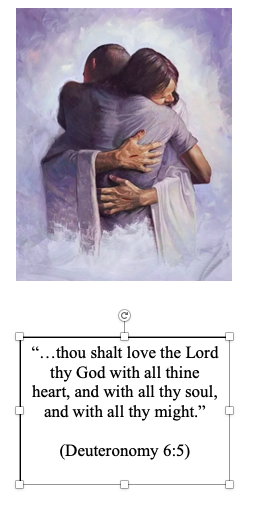
 One of my church callings that I've had for the last two years has been ward bulletin specialist. A small part of the calling that I particularly enjoy is the opportunity to choose the pictures and a scripture to go on the front of it.  I usually like to choose a scripture that fits with the theme of the meeting, but sometimes I don't know what the theme is, so I get to freestyle a little.

Sometimes I've found a picture and then searched for a scripture to match it. Sometimes I have a scripture in mind and I have to choose a picture to match it.  (Google images is not recommended, unless I can find an appropriate image free of copyright restrictions.)

Something I've noticed is how the choice of picture can affect how I interpret the verse I choose. This particularly hit me this week. 

After putting that scripture with this image, I found myself staring at it. I felt my heart begin to yearn to embrace my Savior and my Heavenly Father. I also felt their love for me in a powerful way.  It seemed to me that commandment would be the easiest thing in the world to keep. 

 That verse of scripture lost all its abstraction and has became deep and tender. All because of a picture I paired with it.

Sunday, April 7, 2019 0 comments

Some Challenging Directions from the Lord to the Brother of Jared


And it came to pass that the Lord commanded them that they should go forth into the wilderness, yea, into that quarter where there never had man been. And it came to pass that the Lord did go before them, and did talk with them as he stood in a cloud, and gave directions whither they should travel. (Ether 2:5)

It is interesting that the Lord directed the brother of Jared to take the people into an area where man had never gone before. Now, people are pretty adventurous, so when there’s a place no one has gone before, it is usually because the route looks really forbidding and desolate. So it might have looked like there was a really good reason no one had gone that way.

But if the Lord wanted them to take that route, it was because He knew more about it than man did, that He saw it had the resources to supply their needs even if it didn’t appear to.  (And if it didn’t, He could provide by miracle and build their faith.)  It would take faith to follow the Lord’s directions, trust that it would be alright when appearances were against it.

Not everyone has the faith to do this kind of thing. In Numbers 20:1-8, the children of Israel were led to the desert of Zin where there was no water, and they gathered against Moses to complain, wishing they had died before then and wondering why they had been led there. A miracle brought them water, but even if they hadn’t complained, they would have needed the miracle anyway.  But it would have been better for them if they could have refrained from complaining at all and simply recognized their need for a miracle.

So, lesson #1 – The Lord may lead us in ways that don’t look very possible, and it takes faith to follow.
Lesson #2 – The Lord wants us to learn to depend on Him, so He will bring us by ways that require us to do that.
Lesson #3 – The Lord brings us to places where miracles are required so that we can experience what He is capable of doing. But these places also require a lot of faith from us too.
Lesson #4 – It is best not to murmur when we are stuck and simply realize we need miracles and ask for them.
Friday, March 29, 2019 0 comments

The Five Kings Joshua Conquered: A Type of Christ


16 But these five kings fled, and hid themselves in a cave at Makkedah.
17 And it was told Joshua, saying, The five kings are found hid in a cave at Makkedah.
18 And Joshua said, Roll great stones upon the mouth of the cave, and set men by it for to keep them:….
22 Then said Joshua, Open the mouth of the cave, and bring out those five kings unto me out of the cave.
23 And they did so, and brought forth those five kings unto him out of the cave, the king of Jerusalem, the king of Hebron, the king of Jarmuth, the king of Lachish, and the king of Eglon….
26 And afterward Joshua smote them, and slew them, and hanged them on five trees: and they were hanging upon the trees until the evening.
27 And it came to pass at the time of the going down of the sun, that Joshua commanded, and they took them down off the trees, and cast them into the cave wherein they had been hid, and laid great stones in the cave’s mouth, which remain until this very day. (Joshua 10:16-18, 22-23, 26-27)

In Joshua 10 is told of the five kings that combined to fight against Joshua and Israel. The kings’ forces were discomfited and the kings fled and hid in a cave, and the Israelites were commanded to put stones over the mouth of the cave to keep them in there until the battle was over.  Once the battle was done, Joshua had the kings brought out, and he staged a foot-on-the-neck demonstration to show the Lord would help Israel conquer the land of Canaan. Then he had the five kings killed, hung in the trees until sundown, then thrown back in the cave and great stones laid in the cave mouth.

It seemed to me that what happened to the five kings was a sort of twisted type of Christ, though slightly out of order and in two parts.
First part:  Kings. Kept in a cave (like a tomb), with great stones to prevent them from getting out. With men set by to keep them there. And then they are brought out alive.
Second part: Kings hung on trees until sundown, then put in the cave with great stones over the cave’s mouth.

As you can see, the parts are out of order, so it isn’t a perfect type, but it is still recognizable how it anticipates the crucifixion, the entombment, and resurrection of Christ. And too, Joshua as the high priest orders all of this to happen, taking the part of the Jewish and Roman authorities who condemned Christ.

Monday, January 28, 2019 0 comments

Where the Beauty of Israel Comes From


Ezekiel 16 is an extended allegory of Israel as a woman the Lord finds naked, abandoned, and dirty in the field, and the Lord washes, clothes, and covenants with her and cares for her.

These verses struck me:

13 Thus wast thou decked with gold and silver; and thy raiment was of fine linen, and silk, and broidered work; thou didst eat fine flour, and honey, and oil: and thou wast exceeding beautiful, and thou didst prosper into a kingdom.
14 And thy renown went forth among the heathen for thy beauty: for it was perfect through my comeliness, which I had put upon thee, saith the Lord God.
15 But thou didst trust in thine own beauty… (Ezek. 16:13-15)

This reminds us of an important truth: Israel’s beauty is perfect because it comes from God. It isn’t Israel’s at all, but the goodness Israel is given by grace through obedience.

I think it is also the same on the individual level. Any attractiveness we have is from God. Looks are only surface-deep, but the real attractiveness rests in attitude and outlook and the way we do things, all of which, when affected by and guided by the Lord and our focus on His ways, will be greater than it would be otherwise.  Interestingly, with God’s help, we escape the excessive preoccupation with looks that makes beauty less appealing because our priority are on the things of eternity that really matter.

Let’s not make the mistake of “trusting in our own beauty.” (I’ll leave it to you to look up verse 15 to read the rest of what happens when that mistake is made.)

Sunday, January 20, 2019 0 comments

The Lesson in Darius’ Decree

 
When we were studying Daniel back in December and got to the story of Daniel being protected in the lion’s den, I thought it was really interesting to read the decree King Darius sent out to his people afterwards. You’d think it would be something like, “Daniel’s God does signs and saves and delivered Daniel from the lions,” but there is more to it.

26 I make a decree, That in every dominion of my kingdom men tremble and fear before the God of Daniel: for he is the living God, and steadfast for ever, and his kingdom that which shall not be destroyed, and his dominion shall be even unto the end.
27 He delivereth and rescueth, and he worketh signs and wonders in heaven and in earth, who hath delivered Daniel from the power of the lions. (Dan. 6:26-27)

When even the conquering gentile king acknowledges God’s kingdom will not be destroyed, that’s a strong encouraging message to the Jews. It’s probably the main message of the book to the Jews, who had their kingdom taken over. It’s to remind them that God’s kingdom can exist even if their nation didn’t have independent political power. The Jews of Daniel’s day didn’t yet know that.  
Thursday, January 10, 2019 0 comments

The Recipes for the Anointing Oil and Incense


22 Moreover the Lord spake unto Moses, saying,
23 Take thou also unto thee principal spices, of pure myrrh five hundred shekels, and of sweet cinnamon half so much, even two hundred and fifty shekels, and of sweet calamus two hundred and fifty shekels,
24 And of cassia five hundred shekels, after the shekel of the sanctuary, and of oil olive an hin:
25 And thou shalt make it an oil of holy ointment, an ointment compound after the art of the apothecary: it shall be an holy anointing oil.
26 And thou shalt anoint the tabernacle of the congregation therewith, and the ark of the testimony,
27 And the table and all his vessels, and the candlestick and his vessels, and the altar of incense,
28 And the altar of burnt offering with all his vessels, and the laver and his foot.
29 And thou shalt sanctify them, that they may be most holy: whatsoever toucheth them shall be holy.
30 And thou shalt anoint Aaron and his sons, and consecrate them, that they may minister unto me in the priest’s office.
31 And thou shalt speak unto the children of Israel, saying, This shall be an holy anointing oil unto me throughout your generations.
32 Upon man’s flesh shall it not be poured, neither shall ye make any other like it, after the composition of it: it is holy, and it shall be holy unto you.
33 Whosoever compoundeth any like it, or whosoever putteth any of it upon a stranger, shall even be cut off from his people.
34 And the Lord said unto Moses, Take unto thee sweet spices, stacte, and onycha, and galbanum; these sweet spices with pure frankincense: of each shall there be a like weight:
35 And thou shalt make it a perfume, a confection after the art of the apothecary, tempered together, pure and holy:
36 And thou shalt beat some of it very small, and put of it before the testimony in the tabernacle of the congregation, where I will meet with thee: it shall be unto you most holy.
37 And as for the perfume which thou shalt make, ye shall not make to yourselves according to the composition thereof: it shall be unto thee holy for the Lord.
38 Whosoever shall make like unto that, to smell thereto, shall even be cut off from his people. (Ex. 30:22-38)
In these verses the Lord gives Moses directions for a recipe for holy anointing oil and for incense. The oil was for anointing and sanctifying the tabernacle and the priests. The Incense was to be burned in the tabernacle. Both were to be holy and not used for any other thing outside the tabernacle. Anyone who made it and used it for other purposes was to be cut off (or excommunicated).

Why was this so important? Why was it to be so exclusive?

It seems to me that the Lord was trying to use the power of smells and how they create strong associations with memories and feelings. He wanted a particular set of smells to be associated with the act of anointing and with going into the tabernacle.

Smells create atmosphere, and they are a good symbol for how the Spirit of God creates an atmosphere when present as part of priesthood ordinances and holy places.

Also, often smells of places cling may cling to people, and if people who had been worshipping at the tabernacle had those smells on them, everyone who came close would know where they’d been and what they’d been doing and associate it with the tabernacle and the positive feelings of that. Those associations would strengthen over time. Perhaps those who were distanced from God could be reminded by smelling those smells again from other people around them who worshipped faithfully at the temple.

How might this be useful to us today? What if parents had a particular perfume or cologne they only used after having gone to the temple? It might do the same thing for them and their family.

More lessons I get from these verses:
1)    The anointing oil can symbolize the Spirit of God. If so, then we can’t (and should not try to) imitate the workings of the Spirit. Attempts to imitate would amount to emotional manipulation, which isn’t what the Lord wants. The Lord wants us to imitate Christ’s works, but let the Spirit work as it will.
2)    The incense can represent prayer, since it was to be burned will the priests prayed. Thinking about the ingredients of the incense might make us think about the proper ingredients of prayer—humility, submission, requests for help, gratitude for blessings, confessions for sins, requests for forgiveness, pleas for protection from temptation, requests for guidance, confidences about one’s situation and feelings, praise and adoration for mercy and power manifest, etc.


Update on the Revelation Commentary: I’m still working hard on it!  My word count is up to about 153,000 right now. The whole thing has been drafted, but each chapter requires multiple draft iterations for refinement. I’m very excited about it.
Sunday, October 28, 2018 0 comments

Isaiah 44:1-5 – As Willows by the Water Courses


1 Yet now hear, O Jacob my servant;
and Israel, whom I have chosen:
2          Thus saith the Lord that made thee,
and formed thee from the womb,
which will help thee;
Fear not,
O Jacob, my servant;
and thou, Jesurun, whom I have chosen.
3                                  For I will pour water upon him that is thirsty,
and floods upon the dry ground:
I will pour my spirit upon thy seed,
and my blessing upon thine offspring:
4                                              And they shall spring up as among the grass,
as willows by the water courses.
5 One shall say, I am the Lord’s;
and another shall call himself by the name of Jacob;
and another shall subscribe with his hand unto the Lord,
and surname himself by the name of Israel. (Isaiah 44:1-5)

I like these verses and how easy it is to see the parallelism of repeated thoughts and themes. (I indented at various levels to make it a little more easy to see what things I think go together.)

In verse 1, the Lord is trying to get covenant Israel to listen and is reminding Israel they are chosen and they are His servants. He chose them from the beginning to be His servants. We recognize this because one is not born into the house of Israel by accident, but by design.

Covenant Israel has a tendency to think the job of blessing the entire world is overwhelmingly big, but the Lord tells Israel in v2, “[I] will help thee; Fear not.”

Covenant Israel also recognizes that blessing the whole world is hard work and there are moments when we feel like it would be nice to relax and have others do the teaching for a change. And while we are being examples to the rest of the world, where will we get our examples?  In verse 3, the Lord promises to pour out water (spiritual water) upon those that are thirsty—thirsting after righteousness. “I will pour my spirit upon thy seed, and my blessing upon thine offspring.” It is the Spirit that teaches our children, and often they end up teaching us.

Then there is some beautiful imagery: “they shall spring up as among the grass, as willows by the water courses.”  To understand this, we only need to remember how grass doesn’t grow unless there is plenty of water.  Similarly, willows grow best when very near some sort of river or lake. This is teaching us that with all the spiritual water the Lord pours out through the Holy Ghost, we and our children will grow easily, just like those plants that grow best when there is plenty of water around.

With that kind of spiritual environment, covenant Israel will know for sure they are the Lord’s people. They will be so certain, they will want to take on a new name, perhaps calling themselves Jacob, or Israel, or perhaps consecrating themselves completely to God.

What do I learn from these verses? They tell us to FEAR NOT.  If we draw near to the Lord, He will draw near to us and satisfy our spiritual hunger and yearnings.


Monday, October 8, 2018 0 comments

The Covering of the Tabernacle Equipment


5 And when the camp setteth forward, Aaron shall come, and his sons, and they shall take down the covering veil, and cover the ark of testimony with it:
6 And shall put thereon the covering of badgers’ skins, and shall spread over it a cloth wholly of blue, and shall put in the staves thereof.
7 And upon the table of shewbread they shall spread a cloth of blue, and put thereon the dishes, and the spoons, and the bowls, and covers to cover withal: and the continual bread shall be thereon:
8 And they shall spread upon them a cloth of scarlet, and cover the same with a covering of badgers’ skins, and shall put in the staves thereof.
9 And they shall take a cloth of blue, and cover the candlestick of the light, and his lamps, and his tongs, and his snuffdishes, and all the oil vessels thereof, wherewith they minister unto it:
10 And they shall put it and all the vessels thereof within a covering of badgers’ skins, and shall put it upon a bar.
11 And upon the golden altar they shall spread a cloth of blue, and cover it with a covering of badgers’ skins, and shall put to the staves thereof:
12 And they shall take all the instruments of ministry, wherewith they minister in the sanctuary, and put them in a cloth of blue, and cover them with a covering of badgers’ skins, and shall put them on a bar:
13 And they shall take away the ashes from the altar, and spread a purple cloth thereon:
14 And they shall put upon it all the vessels thereof, wherewith they minister about it, even the censers, the fleshhooks, and the shovels, and the basins, all the vessels of the altar; and they shall spread upon it a covering of badgers’ skins, and put to the staves of it. (Numbers 4:5-14)
In these verses as I was reading I noticed that the Tabernacle equipment was to be covered before it was moved. This emphasized its sacredness and how it was set apart for holy use.

But I also noticed that the manner of covering the objects was not always the same. Moving inward:
·      Altar of sacrifice – covered by purple cloth, then altar vessels/censers/fleshhooks/shovels/ basins, then badger skin.
·      Instruments of ministry in sanctuary – covered by blue cloth, then badger skin.
·      Golden altar of incense – covered by cloth of blue, then badger skin.
·      Candlestick, tongs, snuffers, oil vessels – covered in blue, then badger skin.
·      Shewbread table – covered by blue cloth, then table utensils & shewbread, then scarlet cloth, then badger skin.
·      Ark of the covenant – covered by veil, then badger skin, then blue cloth.

This caused me to ask more questions. Why are some things covered in blue, others by scarlet, and others in purple? Why are some things covered with badger skin on top and the ark isn’t? Is there a progression of change in color as one approaches the holy of holies? Are there any types of Christ present here? Is there a gradation of holiness represented by color or position or number of coverings?

After pondering these different things, it seems to me that there is sophisticated symbolism at work here, teaching things about the Messiah, His nature, and His mission.

First, let’s think about the colors. Blue, scarlet, and purple are used a lot in the robes of the high priest. Blue, with its easy association with the sky, makes us think of the divine and of holiness. Scarlet makes us think of blood, and therefore man in his mortal condition. Purple has several associations. It was a very expensive color at that time, so it was confined to those who had wealth, usually royalty. Also, the color happens to be a mix between blue and red, so it could be in itself a type of Christ, who had both divine and mortal parentage.

The purple cloth that covered the altar of sacrifice says something about the high price of that sacrifice, the fact that Jesus is king of Israel, and His divine-mortal nature.

Many of the things in the holy place were covered with a blue cloth, then with badger skin. The blue makes me think of divinity and badger skin of mortality as well.

The shewbread table, however, had a different kind of covering pattern. The table was first covered with blue cloth, then all the table utinsels and shewbread was placed on it, then covered by scarlet cloth, then badger skin. Why the scarlet?   I think the scarlet was in consideration of how the shewbread represented the twelve tribes of Israel, who were mortal, sinful, and who needed redemption. The shewbread was carried on the blue-covered table, which I think teaches something about how divine power and grace carries us.

The ark of the covenant was first covered with the veil (which separated the holy place from the holy of holies). This made the space under the veil a miniature holy of holies and ensured no unhallowed eyes would see it. Then badgerskin, as all the other things were, and then topped with blue out where all would see it! And the ark would be carried out front. This, I think, teaches first how Christ was a visible example to all of us. Also, I think that blue on the outside teaches that after He died, or passed through the veil, He rose from the dead and regained His glory and ascended into heaven.

That’s a lot of stuff to teach just with the preparations for getting rady to move the Tabernacle! It seems the Lord wanted the priests and Levites to ponder those things and know of His mission even in day-to-day tasks.