Showing posts with label commandments. Show all posts
Friday, February 25, 2022 1 comments

A picture can affect our understanding of the scriptures

 One of my church callings that I've had for the last two years has been ward bulletin specialist. A small part of the calling that I particularly enjoy is the opportunity to choose the pictures and a scripture to go on the front of it.  I usually like to choose a scripture that fits with the theme of the meeting, but sometimes I don't know what the theme is, so I get to freestyle a little.

Sometimes I've found a picture and then searched for a scripture to match it. Sometimes I have a scripture in mind and I have to choose a picture to match it.  (Google images is not recommended, unless I can find an appropriate image free of copyright restrictions.)

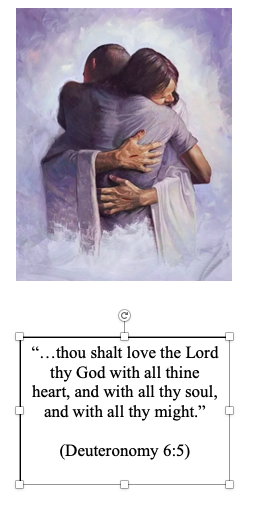
Something I've noticed is how the choice of picture can affect how I interpret the verse I choose. This particularly hit me this week. 

After putting that scripture with this image, I found myself staring at it. I felt my heart begin to yearn to embrace my Savior and my Heavenly Father. I also felt their love for me in a powerful way.  It seemed to me that commandment would be the easiest thing in the world to keep. 

 That verse of scripture lost all its abstraction and has became deep and tender. All because of a picture I paired with it.

Friday, November 2, 2018 0 comments

By the Power of His Word

  Here Alma reminds the people of Zarahemla of what the Lord did for their fathers:

And behold, after that, they were brought into bondage by the hands of the Lamanites in the wilderness; yea, I say unto you, they were in captivity, and again the Lord did deliver them out of bondage by the power of his word; and we were brought into this land, and here we began to establish the church of God throughout this land also. (Alma 5:5)

What strikes me as neat in this verse is this—“the Lord did deliver them out of bondage by the power of his word” (emphasis added). It was simply by telling them “tomorrow you will be delivered” that the Lord was able to save them. The spent the whole night gathering their flocks together to prepare for this (and may have completely worn out their taskmasters who couldn’t keep going) and then when their taskmasters went into a deep sleep, they left and kept going as far and as fast as they could. Because they prepared for the Lord’s promise, they were ready to go. If they hadn’t prepared, they would have had to stay there.

It seems to me that so many of the Lord’s commandments deliver us out of bondage by the power of His word. Tithing delivers us from a bondage to our goods. Chastity delivers us from bondage to our carnal desires. Repentance delivers us from bondage to all sin. Fasting delivers us from bondage to our appetites for food. Service, charity, and families deliver us from bondage to selfishness and self-centeredness. Prayer delivers us from a bondage of emotional separation from God. Are there any commandments that don’t in some way deliver us from some sort of bondage?

I’m so thankful for the freedom that comes from the Lord’s words.
Monday, May 28, 2018 0 comments

Thoughts About Exodus and Why the Pharoah Wouldn’t Let Israel Go


We usually think of the Pharaoh who held the Israelites in bondage in Egypt as a bad guy (not that I’m going to argue he’s good…)  It seems odd that he would be shown all these signs and plagues, and once each one is over, he refuses to let the children of Israel go, after saying he would. Why did he keep hardening his heart?

I think it might be useful to think about what factors might have contributed to his hard heart because they may show us factors that cause us to harden our hearts.

One factor that easily comes to mind is that the Pharaoh saw that once the Israelites were gone, a very profitable source of cheap labor would be gone too. It would be logical to his self-interest and the interest of his kingdom that he would try to prevent that. He would try to intimidate or jolly Moses along in hopes of not losing control of Israelite labor.  Lesson: Loss of material advantages can often prevent us from responding to the Lord’s call if we value the advantage over obedience.

A second factor that might not be so obvious is that God’s actions may have run contrary to Pharaoh’s notions of how a god acts. Pharaoh has his gods, Moses has his God. This conflict could be seen as a cosmic battle between Pharaoh’s gods and Moses’ God. What is Pharaoh going to think of a God that says, “Let my people go”?  He’s going to think Israel’s God is weak. (“A god that asks permission for his people to leave? Right. Make me!”)  However, in the whole story, we see a God that allows people their agency—even hostile rulers—and lets them make decisions to respond to His requests or commands…or not.  And with the plagues that steadily increase in severity, we see that God is long-suffering, willing to wait for people to make the right choice, but ultimately, He can’t be frustrated and He can’t be toyed with.

Another thing we notice about Pharaoh is that when the crisis of a plague is upon him, suddenly he sees the necessity of letting Israel go, or requesting Moses to stop the plague, but as soon as the plague has stopped, he reneges and doesn’t follow through. Once the pain is gone, all thoughts of changing or acting as promised stop. There’s a nice lesson from this—when we’re going through a crisis, it is easy to make all kinds of resolutions that we’re going to change once things get back to normal, but when conditions improve, it is really easy to say, “Oh, I don’t need to do that after all; I’m okay now.” This is the same way Pharaoh hardened his heart.

Let’s review the plagues and see in what ways Pharaoh tries to put Moses off.

1) Moses’ first request is polite, with no plague. Pharaoh, in response, gets tough and makes the Israelite tasks harder by depriving them of ready straw for making bricks while not diminishing their quota they have to provide. In effect, he rewards good with evil, so the Lord has to get tougher. Ever after, Pharaoh can’t do anything to punish the Israelites because of the crisis of plagues.   Lesson: Sometimes we might consider spiritual impressions to change to be some sort of internal rebellion in ourselves or lack of discipline against a comfortable or tolerable status quo, so we tighten the screws and double down on what we’re doing instead of listening.

2) Then there is the miracle of the rods turning to snakes, the water of the river turning to blood, and the frogs. But because Pharaoh’s magicians seem to be able to do the same, Pharaoh hardens his heart. He still things his gods are just as powerful as Israel’s god. We don’t hear anything about the river and waters being healed; we only hear of the request to send away the frogs. (But you can notice that Pharaoh doesn’t actually say he’ll let the Israelites go once the frogs are gone.)  Lesson: Sometimes we refuse to listen to spiritual impressions or signs we need to change or act because we think they are coincidences or something caused by others.

3) Then there is the plague of lice, which the magicians can’t duplicate, so they tell Pharaoh it is Israel’s God at work. Still, Pharaoh hardens his heart, and we don’t see him asking for that to be removed, so maybe he thought it was a small enough problem that everyone could just deal with it.

4) Next comes the plague of flies, and Pharaoh tries to dictate the terms by which the Israelites will act. Moses’ request from the beginning has been that the Israelites be allowed to go out into the wilderness to sacrifice to God (and then not be expected to return.) The Pharaoh says at this point, “Oh, sure you can sacrifice, but do it here in Egypt.” Moses says, “No, we can’t do that, since our sacrifice is abomination to the Egyptians; they will stone us.” (see Ex. 8:26) and he says the Israelites must go at least three days journey into the wilderness. Pharaoh says “That’s fine; just don’t go very far. And pray for me.” So Moses prays for the flies to go away, which they do, and again Pharaoh hardens his heart. 

Pharaoh’s problem here was that he thought that if the intent of letting the Israelites go was sacrifice, then they should be able to do that anywhere. So why not Egypt? He forgot that the Egyptians did not approve of sacrifice, so requiring that would create a hostile, unbelieving environment for what should be a sacred, believing rite.   Lesson: Sometimes we try to dictate the terms of our obedience to the Lord. We try to choose the time and place that is most convenient, when sometimes those very inconveniences we try to ignore are what contribute to the sacredness of the experience.

5) Then there is the plague on the Egyptian cattle, and the boils on man and beast, but Pharaoh’s heart is still hardened. And he doesn’t seem to ask for any reprieve from these. He must have felt that was another thing people could just handle. Lesson: Sometimes we think we can deal with a problem instead of fixing it as we’re prompted to, and it just causes pain for everybody.

6) Then there is the hail, which is mixed with fire. (This may be ball lightning, which still hasn’t been studied much.) It so happens that the Egyptians who believed Moses could save their cattle and servants by bringing them into the house, but apparently Pharaoh didn’t care enough. Still, he asks Moses to stop the hail. Here he tries confession. “I have sinned this time: the LORD is righteous, and I and my people are wicked.” (Ex. 9:27) He promises to let the Israelites go afterward, but when the Lord stops the hail, Pharaoh hardens his heart again. So his confession was fake. You can also see that because he says, “I have sinned this time” (emphasis added). He doesn’t admit that his previous refusals to let them go are also sins. Lesson: Confessing a sin doesn’t do any good unless there is a commitment to act differently and follow-through.

7) The next one is an interesting case. Moses tells Pharaoh that there will be a plague of locusts if the Israelites aren’t let go. Pharaoh responds by telling them that only the men can go (see Ex 10:8-11) and then kicks Moses out so he can’t protest. Pharaoh is trying to hold the Israelite families hostage to ensure the return of the men. Also, he is trying to stop the conversation there so that there is no time for Moses to protest and announce the plague. I notice his servants figuring it out; they know Egypt is in trouble, but Pharaoh doesn’t realize it or refuses to see it.  Lesson: Censoring the Lord’s messenger doesn’t mean you’re off the hook. Also, sometimes it becomes obvious to others around us that we are ignoring the Lord and on the wrong track, while we flail around trying to avoid the inevitable.

Anyway, Moses is in a tricky spot here. Do they take what Pharaoh offers, or do they stick to their guns? The Lord tells Moses to stretch out his hand over Egypt and bring the locusts. And they come.  Lesson: Partial obedience doesn’t fool the Lord. He knows when full obedience is being held back.

After the locusts come, Pharaoh says, “I have sinned against the LORD your God and against you. Now therefore forgive, I pray thee, my sin only this once, and entreat the LORD your God, that he may take away from me this death only.” (Ex. 10:16-17)

Interesting that now Pharaoh admits he sinned against the Lord and against Moses. He has to up his contrition rhetoric to try to get Moses to believe him. (We only see this is rhetoric in hindsight, though, in the moment it could have been sincere, so he has to be believed.) But there are things he says which make us question his sincerity, especially since he says, “Forgive, I pray thee, my sin only this once.” Even though Pharaoh has seen the Lord remove FIVE plagues, he has this idea that he only has to repent once and then everything will be okay after that. (What? Does he think no more plagues are possible and he’s seen the worst?) He doesn’t realize the principle that believers know-- all of us keep transgressing in ways we hadn’t anticipated, so we continue to need repentance. Also there’s another principle that Pharaoh depended upon, but which we sometimes forget (to our torment)—the Lord continues pardon as often as we repent. If the Lord removed plagues at Pharaoh’s request (knowing how hard-hearted Pharaoh was), how much more merciful will He be our complete sincerity and humility? So much more.

The Lord removes the locusts. But then Pharaoh hardens his heart again.

8) The next plague, Moses brings without going to Pharaoh. It is three days of darkness. This time Pharaoh says he will let the Israelites go, but they must leave their cattle in Egypt. He’s still trying to keep hostages, still only trying to get by with 2/3rds obedience.  But since the effect of leaving the cattle means the Israelites would have to go back to Egypt to keep them or stay in the wilderness impoverished, Pharaoh’s agreement is actually not obedience at all, just a complete sham. Lesson: Hypocrisy doesn’t cut it with the Lord either.

Moses holds the line—everyone and everything they own is going with them. Pharaoh does not agree to that and says the next time Moses sees him, Moses will die.

So it has come to threats. Pharaoh seems to think that Moses is the problem and if Moses is gotten rid of, then everything will be okay. The problem is, this has just raised the stakes. Those who dig a pit for others will fall into said pit themselves. So, the Egyptians get the plague of the death of the firstborn.  Lesson:  Getting rid of the leader who transmits the commands of the Lord does not let you off the hook of following those commands.

Let’s sum up what we’ve learned, in a more organized fashion.

Sometimes we have troubles accepting messages from God because:
·      It forces us to sacrifice material advantages
·      It runs counter to our notions of what we think God would tell us.
·      We think it is just self-generated or foolish dissatisfaction.
·      We think it is coincidence or easily duplicated by others.
·      Or we think we can deal with the pain instead of changing.

Once it becomes clear the message really is from God, we still might drag our feet in the following ways:
·      The end of a crisis causes our urgency to fade and our motivation to drop.
·      We might confess our sins of disobedience, but still not change.
·      We might think we can get away with a show of obedience while not actually obeying.
·      We might think we can dictate the terms of the obedience, choosing what’s most convenient.
·      Or we might think that partial obedience is acceptable.
·      We might shorten, edit, re-interpret away the message.
·      Or (the unthinkable) threaten the messenger.

I bet these types of reasons look pretty familiar. But if we recognize ourselves here, recognizing there’s a problem is the first step to fixing it.

What I keep coming back to in this story is how long-suffering and merciful the Lord was with Pharaoh and how that means we can absolutely count on the mercy of the Lord if we repent sincerely and obey completely.


Sunday, May 6, 2018 0 comments

Consequences of Squelching Prophets


10 Then Amaziah the priest of Beth-el sent to Jeroboam king of Israel, saying, Amos hath conspired against thee in the midst of the house of Israel: the land is not able to bear all his words.
11 For thus Amos saith, Jeroboam shall die by the sword, and Israel shall surely be led away captive out of their own land.
12 Also Amaziah said unto Amos, O thou seer, go, flee thee away into the land of Judah, and there eat bread, and prophesy there:
13 But prophesy not again any more at Beth-el: for it is the king’s chapel, and it is the king’s court.
14 Then answered Amos, and said to Amaziah, I was no prophet, neither was I a prophet’s son; but I was an herdman, and a gatherer of sycomore fruit:
15 And the Lord took me as I followed the flock, and the Lord said unto me, Go, prophesy unto my people Israel.
16 Now therefore hear thou the word of the Lord: Thou sayest, Prophesy not against Israel, and drop not thy word against the house of Isaac.
17 Therefore thus saith the Lord; Thy wife shall be an harlot in the city, and thy sons and thy daughters shall fall by the sword, and thy land shall be divided by line; and thou shalt die in a polluted land: and Israel shall surely go into captivity forth of his land. (Amos 7:10-17)

In these verses, Amos is complained of to the king of Israel on the grounds that he is conspiring against the king just because he has said the Lord would raise a sword against the house of Jeroboam.

Who is the complainer? None other than Amaziah, the priest of Bethel. It is not clear whether Amaziah is an idolatrous priest or a priest of Jehovah, but either way, it is ironic that a priest thinks the land can’t bear all Amos’s words. Amaziah also tells Amos to go elsewhere—to Judah, for instance—and prophesy there, but not in the king’s particular place of worship. Amaziah says

Amos responds to Amaziah’s opposition with a prophecy just for Amaziah: that his wife would be a harlot, his children would fall by the sword, his land would be divided among others, he would die in a polluted land, and Israel would go into captivity.

Because Amaziah can’t bear Amos’s words and thinks the land can’t bear them either, Amaziah is not going to tell the truth that needs to be told. That means even if his family begins to sin, he won’t try to stop them, and his family will do worse and worse things.

If Amaziah thinks the land can’t bear the truth, then he’s not going to teach it, and people won’t get a chance to hear the principles that could correct their errors and learn about the Messiah who can save them from their sins. If he doesn’t call for justice and righteousness, then eventually the injustice and wickedness will affect him, and his land will be taken away and divided among others. The people will get worse and worse and go down to destruction.

Even today there are people who, though they call themselves spiritual, can’t understand the scriptures.

Hosea wrote, “I have written to him the great things of my law, but they were counted as a strange thing.” (Hosea 8:12) Some of the things that are most often counted strange from the Law of Moses are the strict prohibitions and penalties against sexual sin or death penalties for sins that are considered trivial today—Sabbath-breaking, dishonoring parents, speaking evil of the leaders of the people, blasphemy.

It’s common to think about the consequences and shudder at the idea of what it would be like if those who were currently in violation were to have the penalties enforced, but who thinks about why such strictness was necessary or whether there was an instructive purpose to it? Whoever considers trying to fit themselves to the principle rather than rejecting it just because the penalties seem fearsome?

It is wonderful to know that commandments are for our blessing, not to ruin our fun. They show us a higher way to live, a way to find an optimum level of happiness that doesn’t injure ourselves or others with excess. They guide us so we can come to find greater long-term happiness, even if the short-term sacrifices look hard. They help us avoid carnal pleasures that would result in long-term suffering and regret.

Saturday, December 16, 2017 0 comments

Various scriptures about “inasmuch”


I ran across a verse that had “inasmuch” in it, and it seemed to me that it expressed proportionality—the bigger one thing is, the bigger another thing is.  So I decided to search for scriptures to see how often I could find this and what I could learn from it.

And the King shall answer and say unto them, Verily I say unto you, Inasmuch as ye have done it unto one of the least of these my brethren, ye have done it unto me. (Matt. 25:40)

To the extent we are charitable to the least of humanity, we are charitable to Christ.

…inasmuch as both in my bonds, and in the defence and confirmation of the gospel, ye all are partakers of my grace. (Phillippians 1:7)

This one is a little tricky to follow, but I think it is staying Paul seems to have noticed that to the extent he was confined but continued to defend and confirm the gospel, he was given grace from God to strengthen others.  That gives some encouragement about our effectiveness for when we feel like we’re hampered by persecution, doesn’t it?

But rejoice, inasmuch as ye are partakers of Christ’s sufferings; that, when his glory shall be revealed, ye may be glad also with exceeding joy. (1 Peter 4:13)

So to the extent that we suffer as Christ did, we will be joyful when His glory is revealed. That gives a good reason to be valiant, doesn’t it?

And inasmuch as ye shall keep my commandments, ye shall prosper, and shall be led to a land of promise; yea, even a land which I have prepared for you; yea, a land which is choice above all other lands. (1 Nephi 2:20)

So to the extent we keep the commandments, we will prosper. This theme is repeated throughout the Book of Mormon. (1 Nephi 4:14; 2 Ne. 1:9; 2 Ne. 1:20; 2 Ne. 4:4; Jarom 1:9; Alma 9:13; Alma 36:1; Alma 38: 1; Alma 50:20)

And inasmuch as thou shalt keep my commandments, thou shalt be made a ruler and a teacher over thy brethren. (1 Nephi 2:22)

This was definitely true of Nephi, and it may very well be true in general—to the extent one keeps the commandments, one is made a ruler and a teacher.

And I will also be your light in the wilderness; and I will prepare the way before you, if it so be that ye shall keep my commandments; wherefore, inasmuch as ye shall keep my commandments ye shall be led towards the promised land; and ye shall know that it is by me that ye are led. (1 Ne. 17:13)

Maybe we are not seeking out a promised land like Nephi, but it is still true that to the extent that we keep the Lord’s commandments we will be led and we will know we are led by God.

And inasmuch as thy brethren shall rebel against thee, they shall be cut off from the presence of the Lord. (1 Nephi 2: 21)

To the extent that we rebel, we are cut off from the Lord’s presence.  Pretty simple.

And the Lord God said unto me: They shall be a scourge unto thy seed, to stir them up in remembrance of me; and inasmuch as they will not remember me, and hearken unto my words, they shall scourge them even unto destruction. (2 Ne 5:25)

So to the extent that we don’t remember God, we will be scourged to destruction. The use of “scourge” here is interesting. A scourge is a whip. It’s not meant to be an execution device, but if it keeps hitting and doesn’t stop, then it becomes one. This scourge is stopped by remembering God and listening to His words. (Oh, look!  Remembering God is part of what we promise to do in the sacrament!)

And it came to pass that they did repent, and inasmuch as they did repent they did begin to prosper. (Helaman 4:15, see also Ether 11:8)

So to the extent that we repent, we prosper.

I’m going to end this post with a triple-packed scripture of inasmuches. 

25 And inasmuch as they erred it might be made known;
26 And inasmuch as they sought wisdom they might be instructed;
27 And inasmuch as they sinned they might be chastened, that they might repent; (D&C 1:25-28)

This tells me I should expect exposure and chastening to the same extent that I err and sin.  There’s fairness in that.  The Lord doesn’t work like the world and overdo it on the chastening. And I love that the Lord tells us that we can be instructed to the extent we seek wisdom.  Doesn’t that just make you want to learn all you can and pray hard for wisdom?


Friday, July 14, 2017 0 comments

Receive Christ to Keep the Law


18 Then said the Pharisees unto him, Why will ye not receive us with our baptism, seeing we keep the whole law?
19 But Jesus said unto them, Ye keep not the law. If ye had kept the law, ye would have received me, for I am he who gave the law.
20 I receive not you with your baptism, because it profiteth you nothing
21 For when that which is new is come, the old is ready to be put away. (JST Matt. 9:18-21)

The first fascinating thing that I notice here is that the Phariess thought they kept the whole law, but Jesus said they didn’t. You have to admire his straightforward truthfulness on the matter. Also it is kind of scary to think someone could be as deluded as the Pharisees were and be so off the mark. We wouldn’t want to be so off ourselves.

Jesus tells them they didn’t keep the law because they hadn’t received Him. This doesn’t make sense if we only think of the law as a series of performances or commandments. But if we remember that the Law of Moses was meant to point to the Messiah who would save from sin all who believed on Him, then it becomes obvious that to keep the commandments while not believing in Christ would profit nothing because one would still remain in one’s sins.

So the Jews had made the mistake of assuming they could do just as well keeping the performances and ordinances of the law even if they didn’t believe Jesus was the Messiah—the one who gave the law and would fulfill it to make repentance possible.  But they were wrong. To reject the one who made the ordinances would mean their ordinances would be worthless.

I think it is possible to fall into the same error today even in the church, to assume we’re alright if we’re keeping the commandments even if we don’t believe in Christ. We might relegate the doctrine of Christ’s atonement to a lesser place and put the commandments and ordinances in a primary place of importance. We might assume we’re doing alright if we’ve been baptized, had our endowments, gotten sealed in the temple, and so on. But none of those profit us if we don’t have faith in Christ.

To look at it in terms of mathematical formulas, it isn’t:

Commandments + Ordinances = Salvation

Where’s Christ? 

A better formula might be:

Faith in Christ * (Commandments + Ordinances) = Salvation

since it represents that if Faith is 0, then nothing else matters.

But then here’s where I can’t leave well enough alone. I’m not sure I’m happy with that one either, since it doesn’t capture how necessary Commandments and Ordinances are.  What if Commandments and Ordinances are both 0? You get zero again.  Or what about if we have only one of those but not the other?

Maybe we have to have a formula like this:

Faith in Christ * Commandments * Ordinances = Salvation

Showing that if any of the factors are missing, you get 0.

What do you think?
Friday, May 26, 2017 3 comments

What we can learn from Nephi’s striving


Wherefore, I, Nephi, did strive to keep the commandments of the Lord, and I did exhort my brethren to faithfulness and diligence. (1 Nephi 17:15)

This verse caught my eye recently. It comes a few verses after Nephi gets the command to build a ship. The word that caught my attention was “strive.”

“Strive” means much much more than “try”; it means “fight or contend.”

So Nephi is saying that he fought to keep the commandments. Interestingly, this verse also comes before Nephi’s brothers realize he’s going to start building a ship, so he hasn’t even begun to preach to them about their murmuring yet. They haven’t begun to murmur; they don’t know a ship-building operation is about to begin.

So the question that came to me next was, “Who was Nephi striving against to keep the commandments in this verse?”

I realized he was fighting himself and his own inclinations. At some level Nephi was reluctant to build the ship. Even though he got busy collecting ore and made a bellows, he still had a part of him that hung back and didn’t want to do it. So he had to fight to be obedient first. And because he fought and won that battle, he was prepared to work to convince his brothers.

I find this realization inspiring and comforting. Throughout Nephi’s story you get the idea that he had little to no internal conflict with himself about doing what the Lord asked him to do. (We see it with killing Laban, but elsewhere hardly at all.)

So it helps me to see that Nephi also had to fight internal battles with himself to be obedient, and it helps to see that in this case he even had to fight them after he’d already begun to be obedient.  It shows that along with having to overcome the temptation of disobedience, we also have to overcome the temptation to slack off once we’ve begun a big hard task to keep the Lord’s commandments.   (I can think of a number of times I’ve been stopped in my tracks a ways in from starting something because the temptation to slack off got to me.) 

I think that realizing that tendency can help us overcome it when we’re faced with it. Instead of saying to ourselves, Ugh, I don’t want to do this; this is such a big job, we can say instead, Ah yes, this is the temptation to quit after having gotten a good start.

Have you noticed this problem affecting you? What do you do to overcome it?
Friday, December 2, 2016 0 comments

Living by the Word of God


This is Moses speaking to the children of Israel about their experiences in the wilderness:

And he humbled thee, and suffered thee to hunger, and fed thee with manna, which thou knewest not, neither did thy fathers know; that he might make thee know that man doth not live by bread only, but by every word that proceedeth out of the mouth of the Lord doth man live. (Deuteronomy 8:3)

We recognize that the Savior paraphrased this verse when tempted by the devil to turn stones into bread after He fasted 40 days. It is possible Christ took the first part “he humbled thee, and suffered thee to hunger” as instruction that He had to endure hunger like other people and be humbled.  Satan probably wanted Christ to focus more on the part, “he…fed thee with manna, which thou knewest not” in order to tempt Christ to turn the stones into bread.

But returning to the children of Israel, how was the miracle of manna supposed to teach them to live by the word of God and not just by bread?

I think it was because of the instructions and commandments associated with gathering the manna.  There were instructions about how much they should gather and when to gather it. There were instructions about not saving it beyond one day. There were even instructions about when they should not expect to gather it—during the Sabbath—and how to compensate for that.

To eat every day, they had to follow those instructions. If they didn’t, they would start to starve. If they persisted in disobedience, they would die. Every instruction had a purpose, and not a single instruction could be neglected without consequences.   I suppose it is always so with the commandments.
Tuesday, May 24, 2016 0 comments

Three Different Ways King Mosiah was Righteous


And it came to pass that king Mosiah did walk in the ways of the Lord, and did observe his judgments and his statutes, and did keep his commandments in all things whatsoever he commanded him. (Mosiah 6:6)
Somehow this verse caught my eye.  It seems to say three different times that Mosiah was a good man and a good king, but with different wording.  This made me wonder if it simply said it three times or if it was describing different aspects of his righteousness.    (Aha, analysis is called for!)

“king Mosiah did walk in the ways of the Lord” – This uses the metaphor of righteousness as a path.  King Mosiah had to know that path—what the Lord’s ways were—in order to walk in it.  He probably asked himself the question, “What would the Lord do?” when faced with something tricky.   Is walking in the Lord’s ways accidental?  No, it has to be deliberate. It has to be learned and practiced.

"[Mosiah] did observe his [the Lord’s] judgments and his statutes" – The word observe has a number of meanings that help us here. 4 of 9 possible definitions are the following:
--show respect towards
--behave as expected during holidays or rites
--stick to correctly or closely
--conform one’s action or practice to

Another interesting thing is that the words “judgments” and “statues” imply the existence of certain things.  Observing judgments in once sense implies noticing the judgments of God at work and pointing out how natural consequences fit with the Lord’s commandments. Or, it might imply sticking with the precedents formed by a body of case law. Observing statutes implies keeping to smaller facilitating laws.

“[Mosiah] did keep his [the Lord’s] commandments in all things whatsoever he commanded him” – This shows us Mosiah received personal revelation and followed it. We get the account of several instances of his doing this. 1) translating the 24 plates Limhi’s people brought with them, and 2) receiving revelation that he should let his four reconverted sons go preach to the Lamanites. Changing the Nephite government from monarchy to a judge-ruled government may have been part of this, but that is only speculation.

So, having examined these things more closely, we see that those three phrases about Mosiah’s righteousness describe different aspects.  It may strike you as it has struck me that they aren’t only for kings.  We also can walk in the ways of the Lord, observe His statutes and judgments in our stewardships, and keep the Lord’s commandments in all things He commands us.    What a heaven this world would be if we all did that.
Tuesday, February 16, 2016 0 comments

Why do the heathen rage?


1 Why do the heathen rage, and the people imagine a vain thing?
2 The kings of the earth set themselves, and the rulers take counsel together, against the Lord, and against his anointed, saying,
3 Let us break their bands asunder, and cast away their cords from us.  (Psalm 2:1-3)

One of the things I learn from these verses is that it is not a new thing for peoples and even rulers of the earth to get impatient with God’s commandments and think of them as restraining bonds that hold them captive.  It is not a new thing for them to plot how to free themselves from the rules and principles and commandments of God so they can do whatever they want.   This has been happening all throughout world history. 

Whoever wrote this Psalm knew the heathen were (would be) offended and rage against the commandments of God and Christ which opposes the carnality of man. 
They think they can easily cast away these cords, but it is not so easy as that.  Commandments and principles are linked together, so rejecting one requires eventually rejecting all the others too.   And soon they are blundering around in uncertainty and darkness, acting so strangely that they seem almost drunk.

Who are the heathen?  Resorting to the dictionary…. :

Heathen: a person who does not belong to a widely held religion (esp. one who is not a Christian, Jew, or Muslim) as regarded by those who do
Also, “a follower of a polytheistic religion; a pagan.”
Also, “(the heathen) heathen people collectively, esp. (in biblical use) those who did not worship the God of Israel.” (emphasis added)
Also, informally, “an unenlightened person; a person regarded as lacking culture or moral principles.”

The problem with resisting the rule of Christ is that the alternative is to have one’s lusts and sins rule one.  That’s how Satan establishes his rule.  And he is really out to enslave, unlike Christ, who wants to purify and exalt humankind.   

What’s neat is that the psalm also states what the Lord will do about this state of things when the heathen refuse His authority.

 4 He that sitteth in the heavens shall laugh: the Lord shall have them in derision.
 5 Then shall he speak unto them in his wrath, and vex them in his sore displeasure.
 6 Yet have I set my king upon my holy hill of Zion.
7 I will declare the decree: the Lord hath said unto me, Thou art my Son; this day have I begotten thee.
8 Ask of me, and I shall give thee the heathen for thine inheritance, and the uttermost parts of the earth for thy possession.
9 Thou shalt break them with a rod of iron; thou shalt dash them in pieces like a potter’s vessel.
10 Be wise now therefore, O ye kings: be instructed, ye judges of the earth.
11 Serve the Lord with fear, and rejoice with trembling.
12 Kiss the Son, lest he be angry, and ye perish from the way, when his wrath is kindled but a little. Blessed are all they that put their trust in him. (Psalm 2: 4-12)

You can detect stages of the Lord’s attempt to reach the heathen.
--He allows them to be laughed at and derided to see if they will respond to shame. (v4)
--He speaks to them in His wrath. (v5) (Notice, He’s still speaking to them. This is the second warning.)
--He vexes them in his sore displeasure.  (v5)(He gives them trials and tribulations, hoping it will stir them up to remember the Lord and repent.)
--But when they will not hear, he will break them with a rod of iron and dash them in pieces. (v9)

This is a predictable pattern. It will happen. It’s as sure as sure.

Ultimately, the psalmist urges the heathen judges and kings and peoples to do the smart thing so they don’t have to go through the pain of chastisement and destruction.  He advises them to submit to the Son (v12) and serve Him (v11).

I couldn’t resist adding here the song “Let us break their bonds asunder” from Handel’s Messiah.


It is fascinating to me how Handel rendered the text into music in his oratorio. It is as if the singers are trying to break out of the confines of the melody and the timing set for them, starting in random places and random times.  You can also hear their anxiousness to get rid of it all in the strenuous emphasis of their words.  

But there is also a lesson to be learned about the consequences of rebellion.  Even though the singers seem to be trying to break the rules of the song, they end up acting in a different pattern, one that is predictable.  Likewise, those who break the commandments may think they are setting their own course and deciding their own fate, but they are merely acting according to a different pattern, one with predictable consequences and which will end with them acting more and more foolishly and getting stuck in misery and sorrow.
Thursday, January 28, 2016 0 comments

What does a culture say about sin?


I ran across this interesting bit from Hugh Nibley that I thought was worth sharing.
Incidentally, it is an interesting thing that repentance is missing from all the ancient religions except the Old Testament. The word repentance doesn’t exist for the Egyptians and the others. I have been reading a lot of Egyptian wisdom literature, and the idea that you should repent [doesn’t exist there]. What you want is luck. They never connected what you have done in the past with your moral behavior. You’ve done what you’ve done, and that’s that. It’s an interesting thing that there is no word in Egyptian for sin.  And in America today sin is having the wrong ideology. It’s being on the wrong side. The Ten Commandments are only fifty percent binding. They bind us but they don’t control our behavior toward bad people. We shall not kill, we shall not lie, we shall not steal from good people. But you can do it with bad people all you want [according to this philosophy]. And they do it everywhere else. We call that revenge because they have been bad. (“Teachings of the Book of Mormon,” semester 2, lecture 52, Alma 19-22, publications.maxwellinstitute.byu.edu)
Really, as a social commentator, Hugh Nibley was excellent.  To distill so many impressions of practical American morality (or lack thereof) at into such a succinct summation is incredibly perceptive.  

Once you know where your culture’s blind-spots are, you can repent and rise above it.
Saturday, July 25, 2015 2 comments

Moses’ pattern for what to tell children about the meaning of the commandments


I like these verses because they have a nice answer to the question “Why do we do these commandments?”  Actually, there are several answers, only implied and three stated.

20 And when thy son asketh thee in time to come, saying, What mean the testimonies, and the statutes, and the judgments, which the Lord our God hath commanded you?
21 Then thou shalt say unto thy son, We were Pharaoh’s bondmen in Egypt; and the Lord brought us out of Egypt with a mighty hand:
22 And the Lord shewed signs and wonders, great and sore, upon Egypt, upon Pharaoh, and upon all his household, before our eyes:
23 And he brought us out from thence, that he might bring us in, to give us the land which he sware unto our fathers.
24 And the Lord commanded us to do all these statutes, to fear the Lord our God, for our good always, that he might preserve us alive, as it is at this day.
25 And it shall be our righteousness, if we observe to do all these commandments before the Lord our God, as he hath commanded us. (Deut. 6:20-25)

The first one is implied.  Because the Lord brought us out of Egypt miraculously and to a promised land [we owe Him allegiance and fealty.]

The next are stated. 

2) “for our good always” – The commandments are for our good.

3) “that he might preserve us alive” – The commandments continue the Lord’s work of salvation in our lives, both temporally and spiritually. They restrict us from harmful acts and require us to do things that help us grow.

4) “it shall be our righteousness, if we observe to do all these commandments” – Obedience leads to a change for the better when coupled with faith in Christ’s atonement.

It is always interesting to see how different people explain the necessity of keeping the commandments of God.  There are so many ways the commandments bless us that keeping them always seems like an adventure.  It's a cheerful thing to live obediently in hope of seeing how the Lord will bless us even if we’re not sure how.